
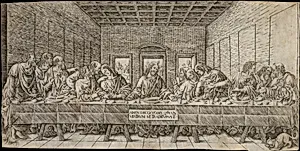
The Last Supper, with a Spaniel
Medium
Engraving
Dimensions
Sheet: 8 3/8 × 17 5/16 in. (21.3 × 44 cm)
Classification
Prints
Department
Drawings and Prints
Museum
Metropolitan Museum of Art, New York, NY
Credit
Purchase, Dr. and Mrs. Goodwin M. Breinin Gift, 1998
Accession Number
1998.195
Rights
Public Domain
Tags
Art Historical Context
This engraving captures Leonardo da Vinci’s renowned composition of the Last Supper, reinterpreted around 1500 by printmaker Giovanni Pietro da Birago. Created just a few years after Leonardo completed his famous Milan fresco, the print translates the dramatic biblical scene—Christ at the center of the table with his disciples—into a portable format. The addition of a lively spaniel beneath the table introduces an unexpected domestic note, softening the solemn moment with a touch of everyday warmth. As an engraving, the work exemplifies the Renaissance interest in reproductive prints, which allowed Leonardo’s innovative ideas about perspective, gesture, and emotional expression to reach audiences far beyond Italy. Birago’s fine linework preserves the original’s careful arrangement of figures and architectural space while adapting it to the demands of the copperplate medium. Housed today in the Metropolitan Museum’s Department of Drawings and Prints, this sheet highlights how early modern printmaking helped shape the lasting fame of Renaissance masterpieces. The presence of the spaniel remains a charming, distinctive detail that invites viewers to linger on the human—and animal—stories unfolding around Christ’s table.
About the Artist
Leonardo da Vinci|Giovanni Pietro da Birago · 1452–1519
Leonardo da Vinci (1452-1519) stands as the quintessential Renaissance polymath, whose genius spanned painting, sculpture, architecture, science, mathematics, engineering, anatomy, geology, cartography, botany, and writing. Born in Vinci, Italy, as the illegitimate son of a notary, Leonardo received limited formal education but demonstrated extraordinary artistic talent from an early age. His appr...