
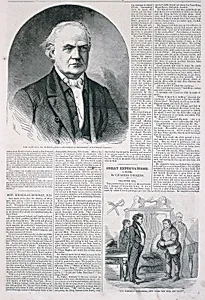
The Late Rev. Dr. Murray, from Harper's Weekly, February 23, 1861
1861
Medium
Graphic Arts-Print
Classification
Graphic Arts-Print
Department
Smithsonian Collection
Museum
Smithsonian American Art Museum
Credit
Smithsonian American Art Museum, The Ray Austrian Collection, gift of Beatrice L. Austrian, Caryl A. Austrian and James A. Austrian
Accession Number
1996.63.203
Rights
Public Domain
Tags
Art Historical Context
Winslow Homer's *The Late Rev. Dr Murray*, published in *Harper's Weekly on February 23,1861, captures a poignant bust portrait of the recently deceased reverend, rendered in the sharp, realistic style that defined Homer's early career as an. At just 25 old, Homer was honing his craft for this influential 19th-century periodical, which brought news, events, and portraits to American households through affordable wood engravings. This graphic arts print exemplifies the era's mass-produced imagery, where detailed line work conveyed solemn dignity in the clergy's likeness. Historically, the artwork appeared on the cusp of the Civil War, amid a nation grappling with division, yet it reflects quieter moments of public mourning and reverence for community leaders like Rev. Dr. Murray. *Harper's Weekly* played a vital role in shaping public opinion, and Homer's contributions—often sourced from his on-the-ground sketches—bridged journalism and art. His precise shading and expressive features highlight the medium's power to humanize figures of authority. Today, housed in the Smithsonian American Art Museum as part of The Ray Austrian Collection, this print offers a window into Homer's evolution from illustrator to one of America's foremost realist painters, blending technical skill with cultural resonance.
About the Artist
Winslow Homer · 1836–1910
Winslow Homer (1836-1910) was one of America's greatest painters and a preeminent figure in 19th-century American art. Largely self-taught, Homer began his career as a commercial illustrator and Civil War correspondent for Harper's Weekly before becoming renowned for his powerful marine subjects and landscape paintings. His mastery of both oil and watercolor, combined with his uncompromising reali...