
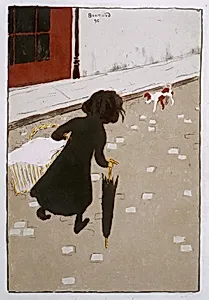
The Laundress (La blanchisseuse)
1896
Medium
color lithograph on china paper
Dimensions
overall: 29.5 x 19.7 cm (11 5/8 x 7 3/4 in.)
Classification
Department
CG-E
Museum
National Gallery of Art, Washington, D.C.
Credit
Virginia and Ira Jackson Collection
Accession Number
1999.138.4
Rights
Public Domain
Art Historical Context
Pierre Bonnard's *The LaundressLa blanchisseuse)* created in 1896, captures an intimate glimpse of everyday life through the lens of a master of Post-Impressionism and the Nabi movement. At just 29.5 x 19.7 cm, this color lithograph on delicate china paper showcases Bonnard's early mastery of printmaking, a medium he embraced to explore vibrant hues and flattened forms inspired by Japanese ukiyo-e prints. The laundress, a humble figure of urban toil, embodies the Nabis' fascination with modern domesticity and the beauty in ordinary moments, reflecting late 19th-century Paris where working women like her were icons of social change. Bonnard's technique here is revolutionary for its time: lithography allowed him to layer bold, unmixed colors directly onto the stone, achieving a luminous, tapestry-like quality on the thin china paper, which enhances the print's jewel-toned intimacy. Printed during his formative years with fellow Nabis like Édouard Vuillard, it highlights his shift from Symbolism toward the joyful, light-filled scenes that defined his later oils. Housed in the National Gallery of Art's Virginia and Ira Jackson Collection, this work invites visitors to appreciate how Bonnard elevated the mundane, blending artistry with the pulse of daily life.
About the Artist
Pierre Bonnard · 1867–1947
Pierre Bonnard (1867–1947) was a French painter and printmaker who became a leading figure in the Post-Impressionist movement and a founding member of Les Nabis. Born on October 3, 1867, in Fontenay-aux-Roses, France, Bonnard initially studied law at his father's insistence, graduating and briefly practicing as a barrister in 1888. However, his true passion lay in art, and he had simultaneously at...