
The Laundress
1896
Medium
lithograph in red, yellow-orange, brown, gray-black and gray-beige
Classification
Department
CG-E
Museum
National Gallery of Art, Washington, D.C.
Credit
Rosenwald Collection
Accession Number
1950.16.5
Rights
Public Domain
Art Historical Context
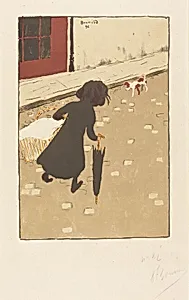
Pierre Bonnard's *The Laundress* (1896) is a vibrant color lithograph that captures the quiet poetry of everyday life. Printed in bold hues of red, yellow-orange, brown, gray-black, and gray-beige, this work from the artist's early career showcases his innovative approach to printmaking. Housed in the National Gallery of Art's Rosenwald Collection (Department CG-E), it exemplifies the flat, decorative patterns Bonnard favored, transforming a simple scene of a woman at her laundry into something luminous and intimate. As a key member of Les Nabis—a Post-Impressionist group influenced by Japanese woodblock prints and Gauguin—Bonnard pushed lithography beyond black-and-white into a symphony of color. Developed in the late 19th century, color lithography allowed artists like him to layer pigments for jewel-like effects, making fine art prints accessible and affordable. This technique was revolutionary for posters and illustrations, bridging fine art and popular culture during Paris's Belle Époque. *The Laundress* reflects the Nabis' fascination with modern domesticity, elevating mundane labor with Bonnard's signature warmth and light. Its subtle tonal shifts and harmonious palette invite viewers to linger, appreciating how ordinary moments hold artistic magic. A gem for print enthusiasts! (198 words)
About the Artist
Pierre Bonnard · 1867–1947
Pierre Bonnard (1867–1947) was a French painter and printmaker who became a leading figure in the Post-Impressionist movement and a founding member of Les Nabis. Born on October 3, 1867, in Fontenay-aux-Roses, France, Bonnard initially studied law at his father's insistence, graduating and briefly practicing as a barrister in 1888. However, his true passion lay in art, and he had simultaneously at...