
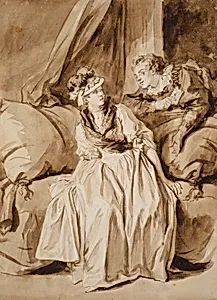
The Letter, or The Spanish Conversation
c. 1778
Medium
Brush and brown ink and brush and brown wash, with graphite, on ivory laid paper
Dimensions
39.9 × 29 cm (15 3/4 × 11 7/16 in.)
Classification
ink or chalk wash
Department
Prints and Drawings
Museum
Art Institute of Chicago
Accession Number
52736
Rights
Public Domain
About this artwork
Jean-Honoré Fragonard’s highly personal, powerful style emerged after periods of study with both François Boucher and Jean-Siméon Chardin, and over five years at the Académie de France in Rome. Entitled The Letter, or The Spanish Conversation (because of the man’s elegant attire—with a doublet of full sleeves and a wide, stiff neck ruff—a costume that was “in the Spanish mode”), this lively sheet depicts with wit and teasing ambiguity an intimate incident in an upper-class drawing room. The arti...
Art Historical Context
Jean Honoré Fragonard a master of the French Rococo style, created *The Letter, or The Conversation* around 177. This delicate drawing on ivory laid paper measures 39.9 × 29 cm and employs brush and brown ink, brown wash, and graphite—a technique that highlights Fragonard's virtuosic command of light and shadow. Housed in the Art Institute of Chicago's Prints Drawings department, it exemplifies artist's shift toward more intimate, monochromatic works late in his career, as Rococo exuberance gave way to Neoclassicism. Fragonard's Rococo sensibility shines through in the drawing's playful ambiguity: the dual title evokes secretive romance or lively dialogue, perhaps with a Spanish flair amid the era's fascination with exoticism. The brown wash lends a soft, atmospheric depth, mimicking oil painting effects while capturing fleeting emotion on paper. Such works were prized by 18th-century collectors for their spontaneity and sensuality, often serving as standalone gems rather than mere studies. This piece invites visitors to savor Fragonard's fluid linework and tonal subtlety, a window into the twilight of Rococo elegance before the French Revolution reshaped art. (198 words)
About the Artist
Jean Honoré Fragonard · 1732–1806
Jean-Honoré Fragonard (1732-1806) was a French painter and printmaker whose late Rococo manner was distinguished by remarkable facility, exuberance, and hedonism. Born in Grasse, he moved to Paris where he trained under Jean-Baptiste Chardin and François Boucher, winning the prestigious Prix de Rome in 1752. After studying in Italy alongside Hubert Robert, Fragonard returned to Paris in 1761 to fi...