
The Little Balcony
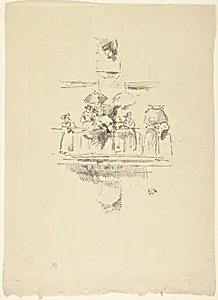
Medium
Transfer lithograph in black on cream laid Japanese vellum
Dimensions
Image: 20.1 × 15.7 cm (7 15/16 × 6 3/16 in.); Sheet: 33.1 × 24.1 cm (13 1/16 × 9 1/2 in.)
Classification
transfer lithograph
Department
Prints and Drawings
Museum
Art Institute of Chicago
Accession Number
73753
Rights
Public Domain
Art Historical Context
James McNeill Whistler’s *The Little Balcony* (1894) captures the artist’s mastery of subtlety and atmosphere in printmaking. Created as a transfer lithograph in black ink on cream laid Japanese vellum this intimate work measures just 20.1 × 15.7 cm for the image, inviting close contemplation. Whistler, the celebrated American expatriate painter known for his “art for art’s sake philosophy and tonal harmonies (as in his famous *Nocturne* series), extended his aesthetic to prints late in his career, producing evocative scenes that prioritize mood over narrative. This piece exemplifies Whistler’s innovative use of transfer lithography, a technique where drawings on transfer paper are offset onto a lithographic stone, yielding soft, painterly effects akin to his oil paintings. The choice of Japanese vellum—smooth yet textured—was deliberate, enhancing ink absorption for delicate gradations of tone. Produced during Whistler’s mature period in London and Paris, it reflects his fascination with everyday urban vignettes, possibly evoking Parisian balconies or Thames-side views from his earlier etching series. Housed in the Art Institute of Chicago’s Prints and Drawings department, *The Little Balcony* showcases Whistler’s influence on modern printmaking, bridging 19th-century Realism with emerging Symbolism. Visitors will appreciate its quiet elegance, a testament to how Whistler transformed humble lithography into high art.
About the Artist
James McNeill Whistler · 1834–1903
James Abbott McNeill Whistler (1834-1903) was an American-born painter and printmaker who became a leading figure in the Aesthetic Movement and pioneer of Tonalism and Japonisme. He revolutionized art by championing "art for art's sake" and treating paintings as visual equivalents of musical compositions, titling works as "arrangements," "harmonies," and "nocturnes" to emphasize formal qualities o...