
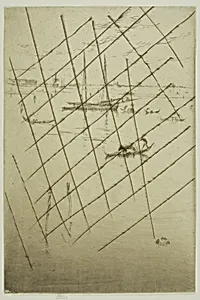
The Little Lagoon
1879/80
Medium
Etching, with drypoint cancellation, in dark brown ink on ivory laid paper
Dimensions
Plate: 22.5 × 15.1 cm (8 7/8 × 6 in.); Sheet: 22.8 × 15.1 cm (9 × 6 in.)
Classification
etching
Department
Prints and Drawings
Museum
Art Institute of Chicago
Accession Number
109170
Rights
Public Domain
Art Historical Context
James McNeill Whistler, renowned 19th-century artist celebrated for his emphasis on tonal harmony and "art for art's sake," created *The Little Lagoon* around 1879–80 during his transformative trip to Venice. Part of his Second Venice Set etchings, this intimate print captures the serene, atmospheric beauty of the city's waterways, evoking a dreamlike tranquility through subtle gradations of light and shadow. Whistler's Aestheticism shines here, prioritizing mood and composition over literal detail, influencing later Impressionists and modern printmakers. Crafted as an etching with drypoint cancellation in dark brown ink on creamy ivory laid paper, the work exemplifies Whistler's virtuoso printmaking. Etching involves drawing lines on a waxed plate that acid etches away, while drypoint adds velvety burrs for rich texture. The cancellation marks—deliberate scratches across the plate—ensure this is an authentic impression from a limited edition, a practice that underscores the rarity and value of his prints. Measuring just 22.5 × 15.1 cm, its compact scale invites close contemplation. Housed in the Art Institute of Chicago's Prints and Drawings department, *The Little Lagoon* highlights Whistler's pivotal role in elevating etching to fine art, bridging Romanticism and modernism while immortalizing Venice's elusive magic for generations of viewers.
About the Artist
James McNeill Whistler · 1834–1903
James Abbott McNeill Whistler (1834-1903) was an American-born painter and printmaker who became a leading figure in the Aesthetic Movement and pioneer of Tonalism and Japonisme. He revolutionized art by championing "art for art's sake" and treating paintings as visual equivalents of musical compositions, titling works as "arrangements," "harmonies," and "nocturnes" to emphasize formal qualities o...