
Whistler with the White Lock
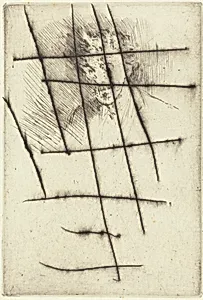
Medium
etching and drypoint on pale green laid paper
Dimensions
plate: 11.75 x 7.94 cm (4 5/8 x 3 1/8 in.) sheet: 22.86 x 17.78 cm (9 x 7 in.)
Classification
Department
CG-W
Museum
National Gallery of Art, Washington, D.C.
Credit
Rosenwald Collection
Accession Number
1943.3.8506
Rights
Public Domain
Art Historical Context
**Whistler with the White Lock is a captivating self-portrait etched by James McNeill Whistler 1879, showcasing the artist's mastery of printmaking. Created as an etching and drypoint on pale green laid paper, this intimate work measures just 11.75 x 7.94 cm on the plate, inviting close contemplation. Housed in the National Gallery of Art'swald Collection, it exemplifies Whistler's commitment to Aestheticism, where "art for art's sake" prioritized harmony, subtlety, and beauty over narrative. Whistler, an American expatriate in Britain, revolutionized etching in the late 19th century by blending precise etched lines—bitten into a metal plate with acid—with the soft, velvety burrs of drypoint, scratched directly into the surface. This technique yields rich tonal depth and texture, capturing the subtle play of light on his features, including the distinctive "white lock" of hair that became a personal signature. By 1879, Whistler had refined these methods through series like his Venice etchings, elevating prints from reproductive tools to fine art. This modest yet evocative piece highlights Whistler's innovative spirit, bridging Impressionist influences with Japanese aesthetics in his pursuit of atmospheric elegance. Visitors will appreciate how it distills his bold personality into delicate lines, a testament to printmaking's enduring allure. (198 words)
About the Artist
James McNeill Whistler · 1834–1903
James Abbott McNeill Whistler (1834-1903) was an American-born painter and printmaker who became a leading figure in the Aesthetic Movement and pioneer of Tonalism and Japonisme. He revolutionized art by championing "art for art's sake" and treating paintings as visual equivalents of musical compositions, titling works as "arrangements," "harmonies," and "nocturnes" to emphasize formal qualities o...