
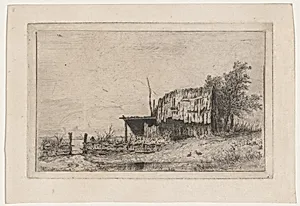
The Little Shed (Le petit Hangar)
mid-19th century
Medium
etching and drypoint on laid paper
Dimensions
plate: 11.9 × 18.9 cm (4 11/16 × 7 7/16 in.) sheet: 15.2 × 22.2 cm (6 × 8 3/4 in.)
Classification
Department
CG-E
Museum
National Gallery of Art, Washington, D.C.
Credit
Gift of James A. Bergquist, Boston, in honor of Shelley R.Langdale
Accession Number
2020.149.3
Rights
Public Domain
Art Historical Context
Nestled in the National Gallery of Art's collection, *The Little Shed (Le petit Hangar)* by Louis Hector François Allemand captures the quiet charm of mid-19th-century French life. Created around the 1840s–1860s, this intimate print depicts a humble coastal structure—likely a boathouse or storage shed—evoking the everyday scenes of rural or seaside France during an era of Romanticism's fade into Realism. Allemand, a lesser-known French etcher, contributed to the vibrant tradition of 19th-century printmaking, where artists like him documented humble architecture and landscapes with meticulous detail. Rendered in etching and drypoint on laid paper, the work showcases masterful techniques of the time. Etching allowed for precise lines etched into a metal plate with acid, while drypoint's direct needle scratches created velvety burrs for rich, textured tones—ideal for conveying the weathered wood and subtle shadows of the shed. Measuring just 11.9 × 18.9 cm on the plate, its small scale invites close viewing, much like a personal sketchbook glimpse into pre-industrial coastal tranquility. Generously gifted by James A. Bergquist in honor of Shelley R. Langdale, this print highlights the enduring appeal of 19th-century French graphics, bridging fine art and everyday observation in the CG-E department's holdings. A testament to printmaking's accessibility, it reminds us how such modest scenes preserve cultural snapshots of a bygone era.