
The Lone Tenement
1909
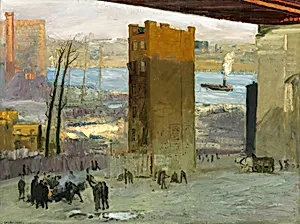
Medium
oil on canvas
Dimensions
overall: 91.8 x 122.3 cm (36 1/8 x 48 1/8 in.) framed: 123.2 x 153.4 x 12.7 cm (48 1/2 x 60 3/8 x 5 in.)
Classification
Painting
Department
CAB
Museum
National Gallery of Art, Washington, D.C.
Credit
Chester Dale Collection
Accession Number
1963.10.83
Rights
Public Domain
Art Historical Context
**The Lone Tenement**, painted by George Bellows 1909, captures the stark realities of early 20th-century New York City through oil on canvas, a medium that allowed Bellows to layer bold, textured strokes for vivid and immediacy. Measuring 91.8 x 122.3 cm, this work exemplifies Bellows' association with the Ashcan School a group of American realist artists who rejected genteel subjects in favor of gritty urban life. The title evokes a solitary tenement building amid the city's overcrowded slums, highlighting isolation amid density—a poignant symbol of immigrant struggles and rapid urbanization. Bellows, a master of dramatic lighting and dynamic composition, used loose brushwork to convey the raw energy of Lower Manhattan's tenements, where poverty and resilience coexisted. Created during the Progressive Era, when reformers spotlighted urban decay, the painting underscores social realism's role in exposing inequality, influencing public awareness much like Jacob Riis' photographs. Housed in the National Gallery of Art's Chester Dale Collection, **The Lone Tenement** remains a testament to Bellows' unflinching gaze, inviting viewers to reflect on the human stories behind the facades of America's booming metropolis. (198 words)
About the Artist
George Bellows · 1882–1925
George Wesley Bellows was born on August 12, 1882, in Columbus, Ohio, the only child of building contractor George Bellows Sr. and Anna Smith Bellows, with an older half-sister, Laura. A talented athlete who excelled in baseball and basketball at Ohio State University from 1901 to 1904, Bellows illustrated for the school yearbook before rejecting a professional baseball contract to pursue art. In ...