
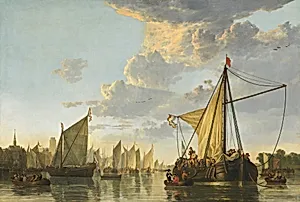
The Maas at Dordrecht
c. 1650
Medium
oil on canvas
Dimensions
overall: 114.9 x 170.2 cm (45 1/4 x 67 in.) framed: 151.1 x 205.1 x 15.2 cm (59 1/2 x 80 3/4 x 6 in.)
Classification
Painting
Department
CNE-B
Museum
National Gallery of Art, Washington, D.C.
Credit
Andrew W. Mellon Collection
Accession Number
1940.2.1
Rights
Public Domain
Art Historical Context
Aelbert Cuyp’s *The Maas Dordrecht*, painted around 0, offers a view of the Dutch river at a pivotal moment the Netherlands’ history. the Dutch Golden Age Dordrecht served as a bustling where trade and naval flourished following the Eighty Years’ War. Cuyp, one of the era’s most admired landscape painters, frequently turned his attention to such river scenes, celebrating the harmony between nature, commerce, and daily life. Executed in oil on canvas, the large work—nearly four by six feet—allowed Cuyp to explore his signature effects of golden sunlight filtering through hazy skies and reflecting on calm water. This technique created a sense of atmospheric depth and warmth that distinguished his style from many contemporaries. The painting’s impressive scale invites viewers to step into the scene, experiencing the quiet majesty of the Maas as ships drift beneath a radiant sky. Today housed in the National Gallery of Art’s Andrew W. Mellon Collection, the canvas remains a compelling example of how Dutch artists transformed ordinary waterways into symbols of national pride and peace.
About the Artist
Aelbert Cuyp · 1620–1691
Aelbert Cuyp (1620–1691), a leading figure of the Dutch Golden Age, was born and died in Dordrecht, Netherlands, where he spent his entire life. The son of portraitist and animal painter Jacob Gerritsz Cuyp (1594–1652), Aelbert came from a family of artists—his uncle Benjamin Gerritsz Cuyp and grandfather Gerrit Gerritsz Cuyp were stained-glass designers—and studied under his father, with whom he ...