
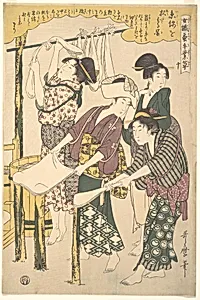
女織蚕手業草 十|The Making of Silk Floss
ca. 1790
Medium
Woodblock print; ink and color on paper
Dimensions
15 x 10 in. (38.1 x 25.4 cm)
Classification
Prints
Culture & Period
Japan · Edo period (1615–1868)
Department
Asian Art
Museum
Metropolitan Museum of Art, New York, NY
Credit
The Howard Mansfield Collection, Purchase, Rogers Fund, 1936
Accession Number
JP2731
Rights
Public Domain
Tags
About this artwork
This prints by japanese artist Kitagawa Utamaro exemplifies the artistic achievements of ca. 1790. Japanese artists developed sophisticated visual traditions with distinct aesthetic principles that profoundly influenced both Eastern and Western art. The artist's work in woodblock print; ink and color on paper demonstrates the importance of printmaking as both an artistic medium and a means of disseminating images widely. Executed in woodblock print; ink and color on paper, this work demonstrates...
Art Historical Context
Kitagawa Utamaro's *The Making of Silk Floss (from the series *Onna Orimugi Tewaza Sō*, ca. 1790) captures the graceful labor of women engaged in sericulture, a vital industry in Edo-period Japan (1615–1868). As a master of uki-e—"pictures of the floating world"—Utamaro in bijin-ga, exquisite portrayals of beautiful women, blending everyday activities with poetic elegance. This woodblock print highlights the meticulous process of silk production, from reeling cocoons to creating floss, reflecting Japan's deep cultural reverence for craftsmanship and harmony with nature. Printed in vibrant ink and color on paper (15 x 10 in.), the work showcases the collaborative genius of ukiyo-e production: artists designed, carvers sculpted cherry woodblocks, and printers applied pigments layer by layer for luminous effects. This technique democratized art, producing affordable multiples that popularized scenes of urban life and women's roles, influencing global aesthetics—later inspiring Impressionists like Whistler and Van Gogh. Housed in the Metropolitan Museum of Art's Asian Art department (The Howard Mansfield Collection, 1936), this print not only exemplifies Utamaro's innovative close-up compositions and subtle shading but also illuminates the economic and social world of 18th-century Japan, where silk weaving empowered women and fueled trade. A window into fleeting beauty and industrious spirit!
About the Artist
Kitagawa Utamaro · 1753–1806
Kitagawa Utamaro (c. 1753-1806) was one of the most celebrated masters of ukiyo-e woodblock printing, revolutionizing the art of bijin-ga (pictures of beautiful women) during Japan's Edo period. Born Kitagawa Ichitaro, his early life remains shrouded in mystery, with conflicting accounts placing his birth in Kyoto, Osaka, Yoshiwara in Edo (modern Tokyo), or Kawagoe in Musashi Province. Under the t...