
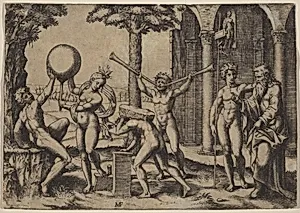
The Man with Two Trumpets
c. 1510-1527
Medium
engraving on laid paper
Dimensions
sheet (trimmed within platemark): 8.2 × 11.7 cm (3 1/4 × 4 5/8 in.)
Classification
Department
CG-E
Museum
National Gallery of Art, Washington, D.C.
Credit
Gift of W.G. Russell Allen
Accession Number
1941.1.70
Rights
Public Domain
Art Historical Context
Marcantonio Raimondi’s *The Man with Two Trumpets* is a delicate engraving created between about 1510 and 1527. Raimondi, one of the most accomplished printmakers of the Italian Renaissance, specialized in translating the compositions of painters such as Raphael into finely detailed prints that could reach a wide audience. Working on a small sheet of laid paper measuring just over three by four and a half inches, he used the engraving technique—incising lines into a copper plate—to achieve crisp, precise contours and subtle tonal gradations that remain legible even at this intimate scale. Engravings like this one played a crucial role in the early sixteenth century by disseminating artistic ideas across Europe at a time when original paintings were accessible only to a privileged few. The compact format suggests the work may have been intended for private collectors or inclusion in albums, allowing viewers to study its imagery closely. The title hints at a figure associated with sound or proclamation, yet the print’s primary interest lies in Raimondi’s masterful control of line and his contribution to the growing appreciation of printmaking as an independent art form. Today the engraving resides in the collection of the National Gallery of Art, a gift that preserves a fine example of Renaissance graphic art for modern audiences.
About the Artist
Marcantonio Raimondi · 1475–1534
Marcantonio Raimondi (c. 1480–1534), born near Bologna, Italy, emerged as one of the Renaissance's premier engravers, revolutionizing printmaking through his mastery of reproductive techniques. He trained in the workshop of the goldsmith, painter, and niellist Francesco Francia, whose influence is evident in his early engravings, such as the goldsmith-like shading in *Pyramus and Thisbe* (1505), h...