
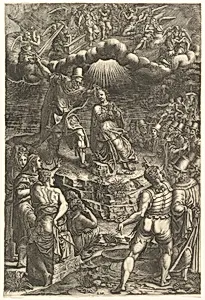
The Martrydom of St. Barbara
late 1570s
Medium
Engraving
Dimensions
sheet: 10 1/2 x 7 1/16 in. (26.7 x 18 cm) borderline
Classification
Prints
Department
Drawings and Prints
Museum
Metropolitan Museum of Art, New York, NY
Credit
Harris Brisbane Dick Fund, 1953
Accession Number
53.600.993
Rights
Public Domain
Tags
Art Historical Context
Welcome to the Metropolitan Museum of Art's Drawings and Prints department, where Giorgio Ghisi's *The Martyrdom of. Barbara* (late 1570s) captivates with its dramatic intensity. This engraving depicts the legendary 4th-century saint, a Christian martyr often shown enduring torture by her pagan father, surrounded by executioners, angels, and divine figures. Ghisi, a masterful Italian engraver active in the Mannerist era drew from religious iconography popular in Counter-Reformation Europe, emphasizing faith's triumph over persecution. Crafted as a precise intaglio print on a modest sheet (10 1/2 x 7 1/16 in.), the work showcases Ghisi's virtuosic technique: intricate cross-hatching and fine lines create depth, texture, and emotional fervor. Engravings like this were revolutionary, allowing affordable reproduction and widespread dissemination of sacred art beyond elite patrons. Acquired through the Harris Brisbane Dick Fund in 1953, it reflects Mannerism's elegant elongation and heightened drama. St. Barbara's story—patron saint of artillerymen and miners—resonates with themes of protection and endurance, making this print a poignant window into 16th-century devotion and artistic innovation.
About the Artist
Giorgio Ghisi · 1520–1582
Giorgio Ghisi (c. 1520–1582) was one of the most accomplished engravers of the Italian Renaissance, renowned for translating the monumental compositions of Raphael, Giulio Romano, and Michelangelo into the exacting medium of the burin. Born in Mantua, he trained in an environment shaped by the legacy of Giulio Romano's decoration of the Palazzo del Te, and the grandeur of that Mannerist tradition ...