
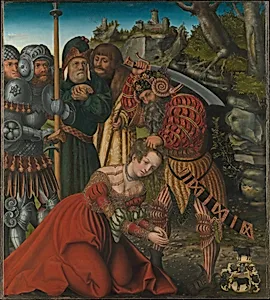
The Martyrdom of Saint Barbara
ca. 1510
Medium
Oil on linden
Dimensions
Overall 60 3/8 x 54 1/4 in. (153.4 x 137.8 cm); painted surface 59 3/8 x 53 1/8 in. (150.8 x 134.9 cm)
Classification
Paintings
Department
European Paintings
Museum
Metropolitan Museum of Art, New York, NY
Credit
Rogers Fund, 1957
Accession Number
57.22
Rights
Public Domain
Tags
Art Historical Context
Lucas Cranach the Elder, a leading figure of the German Renaissance, painted *The Martyrdom of Saint Barbara* around 1510, capturing the dramatic execution of the early Christian saint. Barbara, revered as the patroness of miners and artillerymen, was condemned by her pagan father for her faith and famously beheaded by him after divine intervention destroyed his idols. Cranach's composition vividly portrays her amid soldiers in gleaming armor, swords raised, with her iconic tower symbolizing imprisonment in the background, and a coat of arms adding heraldic detail typical of his courtly patrons. This large oil on linden wood panel exemplifies Northern Renaissance techniques, blending meticulous detail in figures and costumes with a luminous landscape that draws the eye into a spiritual narrative. Cranach's early style here shows influences from his mentor Jakob Walter and contemporaries like Dürer, emphasizing symbolic elements like the saint's serene expression amid violence, which underscores themes of faith triumphing over persecution. Acquired by The Metropolitan Museum of Art through the Rogers Fund in 1957, this work highlights Cranach's skill in religious iconography for Reformation-era audiences, inviting viewers to reflect on martyrdom's enduring power in European art. (198 words)
About the Artist
Lucas Cranach the Elder · 1472–1553
Lucas Cranach the Elder (c. 1472-1553) was one of the most prominent German Renaissance painters and a key artistic figure of the Protestant Reformation. Born in Kronach, Franconia, to the painter Hans Maler, Cranach began his career in Vienna around 1502, where he became one of the founders of the Danube School, a movement characterized by expressive landscape painting and emotional force. His ea...