
The Martyrdom of St. Catherine
ca. 1627
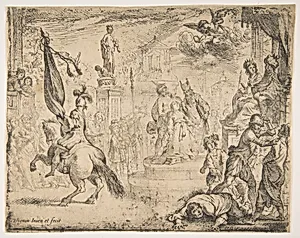
Medium
Etching; second state of two (Pacht Bassani)
Dimensions
sheet: 8 1/4 x 10 3/8 in. (21 x 26.3 cm)
Classification
Prints
Department
Drawings and Prints
Museum
Metropolitan Museum of Art, New York, NY
Credit
Purchase, The Elisha Whittelsey Collection, The Elisha Whittelsey Fund, 1971
Accession Number
1971.558.10
Rights
Public Domain
Tags
Art Historical Context
This dramatic etching by French Baroque artist Claude Vignon created around 1627, captures martyrdom of Saint Catherine of Alexandria, a early Christian saint renowned for her intellect and unyielding faith. Vignon, who absorbed the theatrical lighting and emotional intensity of Caravaggio during his years in Italy, brought a distinctly French flair to religious subjects upon his return to Paris. The print, now in the Metropolitan Museum of Art, presents a crowded, dynamic scene filled with men, women, angels, and horses—elements that heighten the sense of divine intervention and human drama typical of Baroque art. As an etching in its second state, the work demonstrates Vignon’s mastery of the medium, which allowed artists to achieve fine, expressive lines and rich tonal contrasts through acid-bitten copper plates. In the seventeenth century, such prints played a vital cultural role by making complex religious narratives accessible to a wider audience beyond wealthy patrons of painting. Measuring just over eight by ten inches, this intimate sheet invites close inspection of its swirling figures and atmospheric effects, revealing Vignon’s skill in conveying both spiritual triumph and earthly violence. The subject itself held special resonance in Catholic Europe, where Saint Catherine’s story of miraculous deliverance from a spiked wheel followed by her beheading inspired countless artists. Vignon’s interpretation, with its blend of Italianate drama and northern precision, stands as a compelling example of how printmakers helped shape popular devotion and artistic exchange across borders.
About the Artist
Claude Vignon · 1593–1670
Claude Vignon was born on May 19, 1593, in Tours, France, into a wealthy family, and he died on May 10, 1670, in Paris. He received his initial artistic training in Paris under the Mannerist painter Jacob Bunel, a key figure in the Second School of Fontainebleau. Vignon traveled extensively in his youth, likely visiting Rome as early as 1609–1610 and settling there by 1616–1619 among the French ar...