
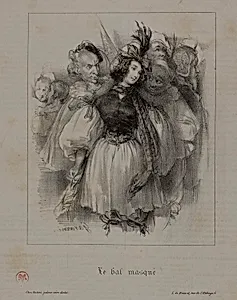
The Masked Ball
1834
Medium
Lithograph in black on ivory wove paper
Dimensions
Image: 15.3 × 12.3 cm (6 1/16 × 4 7/8 in.); Sheet: 30.3 × 22.3 cm (11 15/16 × 8 13/16 in.)
Classification
lithograph
Department
Prints and Drawings
Museum
Art Institute of Chicago
Accession Number
13586
Rights
Public Domain
Art Historical Context
Step into the enchanting whirl of 1830s Paris with *The Masked Ball*, lively lithograph by Paul Gav, created in 1834. Gavarni, a master French caricaturist and illustrator (born Guillaume Sulpice Chevalier), captured the city's vibrant social scene during the July Monarchy era. This print, housed in the Art Institute of Chicago's Prints Drawings Department, depicts the anonymous revelry of a masquerade ball—a staple of Parisian nightlife where class barriers blurred amid costumes, flirtations, and intrigue. Rendered in bold black ink on creamy ivory wove paper (image: 15.3 × 12.3 cm), the work showcases lithography's revolutionary potential. Invented just decades earlier, this technique allowed artists like Gavarni to draw directly on stone for nuanced tones, fluid lines, and mass reproduction, democratizing art beyond elite oil paintings. His keen eye for fashion, gesture, and human folly aligned with the Romantic era's fascination with everyday drama, influencing later Realist movements. *The Masked Ball* offers a window into a culturally electric time, when opera houses like the Opéra Garnier hosted such events, fueling literature from Balzac to Offenbach. Gavarni's witty observation endures, reminding us of the timeless allure of hidden identities and festive escape. (198 words)
About the Artist
Paul Gavarni · 1804–1866
Paul Gavarni, born Sulpice Guillaume Chevalier on January 13, 1804, in Paris to a cooper father from Burgundy and mother Marie-Monique Thiémet—whose brother, painter Guillaume Thiémet, served as his godfather—began his career far from the art world. As a youth, he worked in a machine factory and studied mechanical drawing at the Conservatoire des Arts et Métiers in 1818, followed by evening classe...