
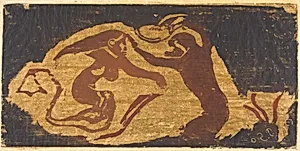
The Mermaid and the Monkey
1826 to 1850
Medium
color woodcut on japan paper
Classification
Department
CG-E
Museum
National Gallery of Art, Washington, D.C.
Credit
Rosenwald Collection
Accession Number
1964.8.2674
Rights
Public Domain
Art Historical Context
In the Prints collection of the National Gallery of, Paul Gauguin's *The Mermaid and the Monkey*ivates visitors as a rare color woodcut on delicate japan paper, part of the esteemed Rosenwald Collection in Department CG-E. Created between 1826 and 1850, this work exemplifies Gauguin's forays into printmaking, where he drew inspiration from Japanese ukiyo-e traditions. The thin, absorbent japan paper enhances the vibrancy of the layered colors, allowing bold, flat areas of hue to evoke a dreamlike, otherworldly quality typical of his Post-Impressionist style. Gauguin, a Symbolist and Primitivist, infused his prints with exotic, mythical themes—here, a mermaid and monkey suggest fantastical narratives blending European folklore with non-Western motifs from his later Tahitian inspirations. Woodcuts like this one marked a technical breakthrough for the artist, as he carved directly into wood blocks to achieve textured, expressive lines and superimposed colors, departing from conventional European engraving. This piece highlights his quest for emotional depth over realism, bridging fine art and accessible reproduction. Displayed among prints, *The Mermaid and the Monkey* invites reflection on Gauguin's cultural wanderlust and innovative spirit, making it a gem for those exploring the roots of modern printmaking.
About the Artist
Paul Gauguin · 1848–1903
Paul Gauguin (1848-1903) was a French Post-Impressionist painter whose bold experiments with color, form, and subject matter made him one of the most influential figures in the transition from 19th-century art to modernism. His rejection of European civilization for the perceived authenticity of 'primitive' cultures established an archetype of artistic exile that continues to resonate. Gauguin's ...