
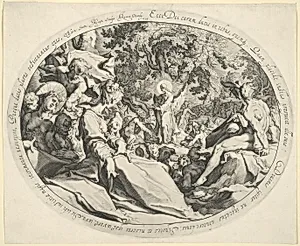
The Miracle of the Five Loaves
Medium
Engraving in black on ivory laid paper
Dimensions
Image: 22.6 × 29 cm (8 15/16 × 11 7/16 in.); Plate: 25.5 × 31.9 cm (10 1/16 × 12 9/16 in.); Sheet: 26.9 × 32.7 cm (10 5/8 × 12 7/8 in.)
Classification
engraving
Department
Prints and Drawings
Museum
Art Institute of Chicago
Accession Number
29953
Rights
Public Domain
About this artwork
Jacob de Gheyn II’s oval engraving of Christ’s miracle of the loaves and fishes elegantly references this event in which the masses, who had come to hear Christ’s sermon, were fed by his multiplying the few crusts of bread and pieces of fish the disciples had procured. Once again, the miracle of replication appears at the heart of the Christian tradition, making print an optimal medium for depicting its holy stories and cult objects. That the engraving plate is an oval platter offers an addition...
Art Historical Context
Jacques de Gheyn II's *The Miracle of the Fiveaves* (1595) captures a pivotal biblical moment from the New Testament: Jesus feeding the 5,000 with just five loaves and two fishes. This intricate engraving, housed in the Art Institute of's Prints and Drawings department exemplifies the artist's mastery during the late Northern Renaissance. Gheyn (1565–1629), a Dutch Mannerist renowned for his detailed prints and drawings, trained in Antwerp and later influenced figures like Rembrandt, blending elegant linework with dramatic narrative. Rendered in black ink on rare ivory laid paper, the work measures about 22.6 × 29 cm for the image alone, showcasing engraving's precision—tiny burin incisions create rich textures and depth. Prints like this were revolutionary, allowing religious scenes to reach wide audiences beyond elite patrons amid the Netherlands' religious upheavals post-Reformation. Gheyn's composition draws viewers into the crowd's awe, highlighting faith's abundance. A gem for print enthusiasts, it reveals Mannerism's stylized grace and the era's devotional fervor.
About the Artist
Jacques de Gheyn, II · 1565–1629
Jacques de Gheyn II (1565–1629) was born in Antwerp into an artistic family, receiving his earliest instruction from his father, Jacob de Gheyn I, a skilled glass painter, engraver, and draftsman. In 1585, the young de Gheyn moved to Haarlem, where he spent five formative years studying under Hendrik Goltzius, one of the most celebrated engravers of the Northern Renaissance. This apprenticeship pr...