
The Miraculous Draught of Fishes
Medium
Chiaroscuro woodcut from three blocks in brown
Dimensions
Sheet: 9 1/8 × 15 3/8 in. (23.2 × 39 cm)
Classification
Prints
Department
Drawings and Prints
Museum
Metropolitan Museum of Art, New York, NY
Credit
Rogers Fund, 1922
Accession Number
22.67.39
Rights
Public Domain
Art Historical Context
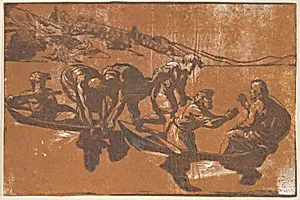
Behold *The Miraculous Dra of Fishes*, a chiaroscuro woodcut around 1540–50 by Niccolò Vicentino a design by the High Renaissance Raphael (Raffaellozio da Urbino). This print depicts the biblical miracle from the Gospel of Luke, where Jesus instructs his disciples to cast their nets into the sea, resulting in an overflowing catch of fish—a powerful symbol of divine abundance and the call to apostleship. Raphael's graceful figures and dramatic composition capture the Renaissance ideal of harmony and humanism, faithfully reproduced here to bring his genius to a wider audience. Vicentino's mastery shines in the innovative chiaroscuro technique, using three woodblocks in shades of brown to mimic the subtle play of light and shadow found in oil paintings. Developed in 16th-century Italy, this method elevated woodcuts from simple black-and-white illustrations to tonal masterpieces, rivaling engravings in depth and expressiveness. Printed on a modest sheet (9 1/8 × 15 3/8 in.), it exemplifies how prints democratized art during the Renaissance, allowing collectors across Europe to own Raphael's vision posthumously—he had died in 1520. Acquired through the Rogers Fund in 1922 and housed in the Metropolitan Museum of Art's Drawings and Prints department, this work highlights the era's fusion of faith, artistry, and technology. A testament to Raphael's enduring influence, it invites you to marvel at the miracle unfolding in intricate line and shadow.
About the Artist
Niccolò Vicentino|Raphael (Raffaello Sanzio or Santi) · 1540–1550
**Niccolò Vicentino (also known as Giuseppe Niccolò Rospigliosi or Rossigliani, called Vicentino)** was an Italian Renaissance painter and wood-engraver active primarily in the mid-16th century. Born in Vicenza around 1525, he worked in Bologna circa 1550. He specialized in the demanding technique of chiaroscuro woodcuts, which use multiple blocks to create tonal effects of light and shadow. He w...