
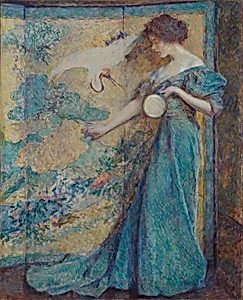
The Mirror
ca. 1910
Medium
Painting
Classification
Painting
Department
Smithsonian Collection
Museum
Smithsonian American Art Museum
Credit
Smithsonian American Art Museum, Gift of William T. Evans
Accession Number
1911.2.4
Rights
Public Domain
Tags
About this artwork
American Impressionism emerged in the late 1880s when a generation of American artists studied abroad to absorb the new palette and compositions that were modernizing painting in France. Landscapes and domestic scenes by these American Impressionists are as wonderfully fresh and sparkling as those by their more familiar French counterparts. These artists, attracted to the light and color of painting outdoors, celebrate a modern view of life as America entered the twentieth century.
Art Historical Context
Robert Reid's *The Mirror* (ca. 1910) captures the essence of American Impressionism, a movement that blossomed in the late 1880s as U.S. artists traveled to France to embrace vibrant palettes and loose brushwork. Reid, a prominent muralist and painter, infused his works with the sparkling light and color that defined this style, turning everyday moments into celebrations of modern American life at the dawn of the twentieth century. This oil painting, now in the Smithsonian American Art Museum thanks to a gift from William T. Evans, exemplifies the genre's focus on domestic intimacy. Depicting a full-length figure before a mirror and ornate screen, *The Mirror* likely explores themes of reflection and femininity in a luminous interior. American Impressionists like Reid favored such scenes over grand narratives, using dappled light and soft edges to evoke transience and beauty—much like their French inspirations, Monet and Renoir, but with a distinctly optimistic American flair. The composition draws the eye to shimmering surfaces, highlighting Reid's skill in rendering textiles and reflections with fresh, impressionistic strokes. Housed in the Smithsonian's collection, this piece invites visitors to appreciate how Impressionism bridged Old World techniques with New World vitality, marking a pivotal shift in American art toward personal, joyful expression.