
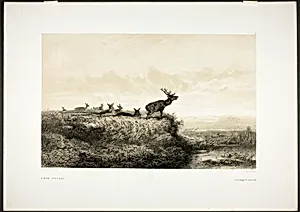
The Morning: Stags and Does
1858
Medium
Tint lithograph on white wove paper
Dimensions
Image: 29 × 46.1 cm (11 7/16 × 18 3/16 in.); Sheet: 45 × 63 cm (17 3/4 × 24 13/16 in.)
Classification
lithograph
Department
Prints and Drawings
Museum
Art Institute of Chicago
Accession Number
129374
Rights
Public Domain
Art Historical Context
Karl Bodmer’s *The Morning: Stags and Does* captures a tranquil woodland scene at dawn, where a small herd of deer pauses in soft morning light. Created in 1858, the lithograph reflects Bodmer’s lifelong fascination with the natural world, honed during his earlier travels across North America in the 1830s, when he documented landscapes and wildlife with meticulous observation. By the late 1850s, working from his studio in France, he turned this precision toward European subjects, translating the quiet drama of nature into print form. The work is a tint lithograph, a medium that allowed artists to layer subtle colors over a black-and-white base, giving the scene atmospheric depth without the labor of hand-coloring each impression. Printed on fine white wove paper, the large sheet size (45 × 63 cm) suggests it was intended for display rather than book illustration, inviting viewers to linger over the gentle modeling of the animals’ coats and the hazy background foliage. Bodmer’s print exemplifies the nineteenth-century taste for romantic naturalism, where scientific accuracy met poetic mood. Today in the Art Institute of Chicago’s collection, it offers a window onto an era when advances in printmaking brought vivid images of the animal kingdom into homes and galleries across Europe and America.
About the Artist
Karl Bodmer · 1809–1893
Johann Carl Bodmer was born on February 11, 1809, in Zürich, Switzerland, and received his training as a painter and engraver under his uncle Johann Jakob Meier, who had himself studied under the prominent engraver Heinrich Füssli. By the late 1820s Bodmer had relocated to Koblenz, Germany, where his work came to the attention of Prince Maximilian zu Wied-Neuwied, a German naturalist-explorer plan...