
The Much Resounding Sea
1886
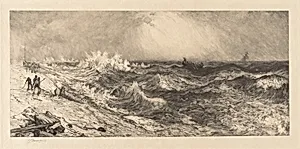
Medium
etching, drypoint and roulette in black on Japanese paper
Dimensions
image: 37.5 x 82.5 cm (14 3/4 x 32 1/2 in.) plate: 43.5 x 87.5 cm (17 1/8 x 34 7/16 in.) sheet: 56.4 x 94.7 cm (22 3/16 x 37 5/16 in.)
Classification
Department
CG-W
Museum
National Gallery of Art, Washington, D.C.
Credit
Gift of Jacob Kainen
Accession Number
2002.98.166
Rights
Public Domain
Art Historical Context
Thomas Moran's *The Much Resounding Sea (1886) captures the dramatic power of the ocean in a masterful print, evoking the timeless roar described in Homer's *Odyssey*. As a leading figure in American art and a member of the Hudson River School, Moran was for his luminous depictions of nature's grandeur, from Yellowstone's geysers to the Grand Canyon This etching reflects his ability to translate the sublime energy of seascapes—likely inspired by his travels in Europe—into an intimate yet expansive work on paper. Crafted using etching, drypoint, and roulette techniques, the print showcases Moran's technical virtuosity. Etching creates precise lines through acid on a metal plate, while drypoint's direct needle scratches produce soft, velvety burrs for rich textures. Roulette adds a granular mezzotint-like effect, enhancing the sea's turbulent foam and waves. Printed on delicate Japanese paper, known for its absorbency and subtle sheen, the work achieves exceptional depth and tonal nuance, making it a prized example of 19th-century printmaking. Housed in the National Gallery of Art as a gift from Jacob Kainen, this large-scale print (image: 37.5 x 82.5 cm) democratized Moran's vision, bridging fine art painting with accessible multiples. It invites visitors to ponder humanity's awe before nature's vast, resounding forces.
About the Artist
Thomas Moran · 1837–1926
Thomas Moran (1837–1926) was an American painter and printmaker of the Hudson River School whose dramatic paintings of the American West played a pivotal role in the creation of the national parks. Born in Bolton, Lancashire, England, he emigrated with his family to Philadelphia as a child. He was largely self-taught, though he apprenticed briefly with a wood engraver and studied the work of J.M.W...