
The Muse: History
ca. 1865
Medium
Oil on canvas
Dimensions
18 1/8 x 13 7/8 in. (46 x 35.2 cm)
Classification
Paintings
Department
European Paintings
Museum
Metropolitan Museum of Art, New York, NY
Credit
H. O. Havemeyer Collection, Bequest of Mrs. H. O. Havemeyer, 1929
Accession Number
29.100.193
Rights
Public Domain
Tags
Art Historical Context
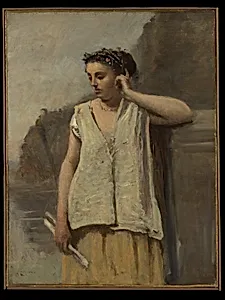
In the serene glow of Camille Corot's *The Muse: History* (ca. 1865), we encounter a poetic embodiment of Clio, the ancient Greek Muse of history and heroic epic. Painted in oil on canvas, this intimate work measures just 18 1/8 x 13 7/8 inches, inviting close contemplation. Corot, a leading figure of the Barbizon School and a bridge between Romanticism and Impressionism, captures the muse with his signature soft, atmospheric touch—diffused light filtering through a dreamlike haze, evoking timeless introspection. Corot's masterful handling of oil allows for velvety transitions in flesh tones and drapery, blending figure and landscape in a harmonious whole. By mid-century France, amid cultural reverence for classical antiquity, depicting muses symbolized inspiration's enduring power. This piece reflects Corot's late-career fascination with idealized women, infusing mythological subjects with emotional depth and naturalism that influenced younger artists like the Impressionists. A gem from the H.O. Havemeyer Collection, bequeathed to the Metropolitan Museum of Art in 1929, *The Muse: History* reminds us how art preserves the stories of the past, much like Clio herself.
About the Artist
Camille Corot · 1796–1875
Jean-Baptiste-Camille Corot, born in Paris on July 16, 1796, into a prosperous bourgeois family—his father a former wig maker turned draper, his mother a successful milliner—initially resisted his artistic calling. After a lackluster education at the Lycée Pierre-Corneille in Rouen and failed apprenticeships in business, he abandoned commerce at age 26, thanks to a generous parental allowance foll...