
The Muse Terpsichore
c. 1768
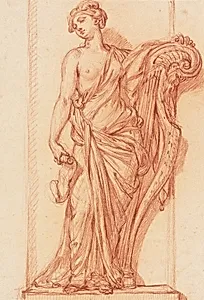
Medium
red chalk on laid paper
Dimensions
overall: 30 x 20.5 cm (11 13/16 x 8 1/16 in.)
Classification
Drawing
Department
CG-E
Museum
National Gallery of Art, Washington, D.C.
Credit
Ailsa Mellon Bruce Fund
Accession Number
1997.39.1
Rights
Public Domain
Art Historical Context
Augustin Pajou’s *The Muse Terpsichore* offers a graceful glimpse into eighteenth-century French draftsmanship. Created around 1768, the drawing portrays the Greek muse of dance and choral song, a figure frequently invoked in the period’s decorative and theatrical commissions. Pajou, best known as a sculptor who helped bridge the waning Rococo style and the emerging Neoclassicism, used such studies to explore idealized poses and drapery before translating them into marble or plaster. The choice of red chalk on laid paper was especially suited to this task. The medium’s warm tone and ability to produce both delicate lines and soft tonal modeling allowed Pajou to suggest the gentle turn of the figure’s head and the flowing rhythm of her garments with remarkable sensitivity. At roughly 30 by 20.5 centimeters, the sheet’s intimate scale invites close looking, revealing the artist’s careful attention to contour and light. Acquired through the Ailsa Mellon Bruce Fund, this work now resides in the National Gallery of Art’s collection of French drawings. It exemplifies how preparatory studies of mythological subjects helped shape the refined visual language of the Enlightenment era.
About the Artist
Augustin Pajou · 1730–1809
Augustin Pajou (1730–1809) was one of the foremost French sculptors of the second half of the eighteenth century, whose long and distinguished career bridged the Rococo grace of the Ancien Régime and the more sober classicizing spirit that emerged in the revolutionary and Napoleonic periods. Born in Paris into a family with artistic connections — his father was an ornamental sculptor — Pajou showe...