
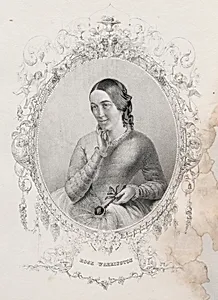
The National Plumbeotype Gallery - Rose Warrington
Medium
Classification
Department
Smithsonian Collection
Museum
Smithsonian American Art Museum
Credit
National Portrait Gallery, Smithsonian Institution
Accession Number
NPG.78.84.T
Rights
Public Domain
Tags
Art Historical Context
Step into the dawn of American photography with *The National Plumbeotype Gallery - Rose Warrington* (1847), a charming print by John Plumbe, Jr., a pioneering daguerreotypist and entrepreneur. Plumbe, born in 1809, established one of the first photography studios in the U.S., promoting his "Plumbeotype" process—a refined daguerreotype technique—as a faster, more accessible alternative to painted portraits. This work captures the elegance of Rose Warrington, adorned with a delicate fan and feather, surrounded by playful putti (cherubic figures), evoking the decorative flair of 19th-century portraiture. As a print reproduced from a daguerreotype, it highlights the era's technological leap: photography democratized portraiture, making professional likenesses affordable for the growing middle class. Produced amid America's pre-Civil War optimism, Plumbe's gallery promotions like this one advertised his national chain of studios, blending artistry with commerce. Housed in the Smithsonian American Art Museum's National Portrait Gallery collection, it exemplifies how early photographers bridged classical portrait traditions with innovative mediums. Fun fact: Plumbe, a railroad advocate, saw photography as an "iron road" to visual truth, capturing fleeting moments with unprecedented detail. This piece invites us to ponder a young woman's poised gaze amid feathers and fantasy, a snapshot of 1840s aspiration. (198 words)