
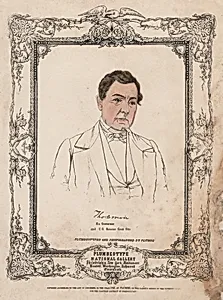
The National Plumbeotype Gallery - Thomas Corwin
Medium
Classification
Department
Smithsonian Collection
Museum
Smithsonian American Art Museum
Credit
National Portrait Gallery, Smithsonian Institution
Accession Number
NPG.78.84.J
Rights
Public Domain
Tags
Art Historical Context
In 1847, pioneering photographer John Plumbe,., captured the likeness of Thomas Corwin inThe National Plumbeotype - Thomas Corwin*, a striking print that exemplifies early American portraiture. Plumbe, an Irish-born innovator who established the Plumbe National Daguerrean in New York—the nation's first major photography studio—created this image as part of his celebrated series reproducing daguerreotypes via lithography. The portrait features Corwin, a prominent Ohio, Whig politician, and future Secretary of the Treasury under President Millard Fillmore, often depicted with patriotic symbols like the eagle, underscoring his role in national politics. This work holds historical significance as one of the earliest efforts to mass-distribute photographic portraits through affordable prints, bridging the gap between cutting-edge daguerreotypy and traditional printmaking. Plumbe's "Plumbeotype" process democratized access to images of America's leaders, fostering a visual culture of celebrity and nationalism during the Mexican-American War era, when Corwin served as a key diplomat. Housed in the Smithsonian American Art Museum's National Portrait Gallery, it offers a window into mid-19th-century innovation, where photography began reshaping how we see power and identity.