
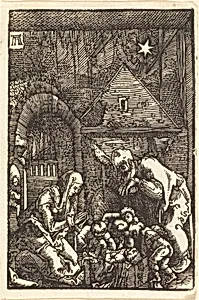
The Nativity
c. 1513
Medium
woodcut on laid paper
Dimensions
block: 7.2 × 4.9 cm (2 13/16 × 1 15/16 in.) sheet: 7.7 × 5.1 cm (3 1/16 × 2 in.)
Classification
Department
CG-E
Museum
National Gallery of Art, Washington, D.C.
Credit
Gift of W.G. Russell Allen
Accession Number
1941.1.117
Rights
Public Domain
Art Historical Context
Albrecht Altdorfer's *The Nativity* (c. 1513) captures the sacred moment of Christ's birth in a diminutive woodcut, measuring just 7.2 × 4.9 cm on laid. A leading figure of the German Renaissance and the Danube School Altdorfer blended intricate landscapes with religious themes, infusing biblical scenes with a sense of European naturalism and atmospheric depth. Created during the early 16th century, printmaking revolutionized the spread of devotional imagery, this work reflects the era's growing demand for affordable, portable art for personal piety amid the Reformation's stirrings. Woodcuts like this one were carved into wooden blocks and printed, allowing for bold lines and fine details despite the medium's limitations. Altdorfer's mastery shines in the tiny scale, where he evokes the humble stable, adoring figures, and starry night sky with remarkable precision—hallmarks of his innovative style that anticipated Mannerism. Laid paper, a high-quality European standard of the time, preserved the crisp contrasts essential to woodcut's expressive power. Housed in the National Gallery of Art as a gift from W.G. Russell Allen, *The Nativity* exemplifies how small prints democratized Renaissance art, bridging elite workshops and everyday worshippers. Its intimate size invites close contemplation, reminding us of art's enduring role in spiritual life.
About the Artist
Albrecht Altdorfer · 1475–1538
Albrecht Altdorfer (c. 1480–1538) was a German painter, printmaker, and draftsman who stands as one of the founders of landscape painting as an independent genre. Born in Regensburg or nearby Altdorf, he learned art from his father Ulrich, a painter and miniaturist. Altdorfer spent most of his life in Regensburg, becoming a citizen in 1505 and later serving as the city's official architect and a m...