
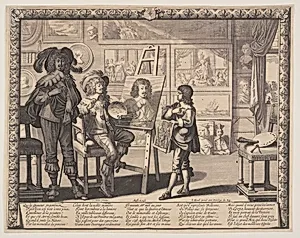
The Noble Painter
c. 1642
Medium
Etching on ivory laid paper
Dimensions
Sheet (trimmed): 25.8 × 32.6 cm (10 3/16 × 12 7/8 in.)
Classification
Department
Prints and Drawings
Museum
Art Institute of Chicago
Accession Number
268400
Rights
Public Domain
Art Historical Context
Abraham Bosse’s “The Noble Painter,” created around 1642, is a fine example of 17th-century French printmaking. Working in Paris during the reign of Louis XIII, Bosse specialized in detailed etchings that captured the professions, manners, and social aspirations of his time. His works often blended observation with gentle commentary, presenting ordinary figures with clarity and wit. The etching’s title suggests an effort to elevate the status of painters, portraying the artist not as a mere craftsman but as a figure of dignity and intellect. Executed on ivory laid paper, the medium allowed Bosse to achieve delicate lines and subtle tonal contrasts that brought everyday scenes to life. Such prints circulated widely, helping to shape public appreciation for the visual arts in an era when painting was still seeking full recognition among the liberal arts. Housed in the Art Institute of Chicago’s Prints and Drawings collection, this sheet (measuring roughly 10 by 13 inches) offers modern viewers a window into both artistic self-perception and the vibrant print culture of Baroque France.
About the Artist
Abraham Bosse · 1602–1676
Abraham Bosse (1604–1676) was a French printmaker and theorist whose approximately 1,600 etchings provide an unparalleled visual record of 17th-century French life. Born to Huguenot parents in Tours, he trained in Paris under Melchior Tavernier and became a devoted follower of Jacques Callot's technical innovations. Bosse's meticulous etchings depicted subjects ranging from daily life and fashion ...