
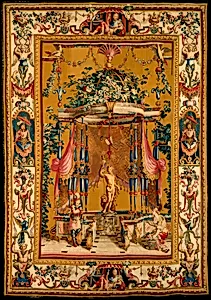
The Offering to Bacchus (from a set of five Berain Grotesques)
designed ca. 1688, woven ca. 1690–1711
Medium
Wool, silk (21-27 warps per inch, 8-9 per cm.)
Dimensions
9 ft. 7 in. × 80 in. (292.1 × 203.2 cm)
Classification
Textiles-Tapestries
Culture
French, Beauvais
Department
European Sculpture and Decorative Arts
Museum
Metropolitan Museum of Art, New York, NY
Credit
Gift of John M. Schiff, 1977
Accession Number
1977.437.4
Rights
Public Domain
Tags
Art Historical Context
In this large wool-and-silk tapestry, a luminous golden-yellow field dominates the center, drawing the eye to a canopied pavilion brimming with flowers and greenery. A youthful nude figure stands on a pedestal, one arm raised as if presenting an offering, while attendants in colorful classical dress gather at the base. The scene is enclosed by a wide border alive with fantastical grotesques—winged putti, birds, garlands, and small figures—that climb vertical panels and fill the top and bottom registers with additional mythological vignettes. Designed around 1688 by Jean Berain and woven at the Beauvais manufactory between about 1690 and 1711, this piece belongs to a set of five tapestries known as the Berain Grotesques. Jean-Baptiste Monnoyer supplied the abundant floral motifs, and Guy Louis Vernansal the Elder contributed the figural groups. The composition revives the ancient Roman grotesque style popular at the French court, combining playful ornament with Bacchic imagery to create an elegant, lighthearted decoration suited to the grand interiors of the period.
About the Artist
Jean-Baptiste Monnoyer|Philippe Béhagle|Beauvais|Jean Berain|Guy Louis Vernansal the Elder · 1636–1699
Jean-Baptiste Monnoyer (1636-1699) was a Franco-Flemish painter who became the most distinguished and formative still life and flower painter of the French Baroque period. Born in Lille, he trained in Antwerp where he absorbed the techniques of Flemish masters before moving to Paris by 1650. Patronized by Charles Le Brun, Louis XIV's Minister of Arts, Monnoyer worked extensively on decorative pain...