
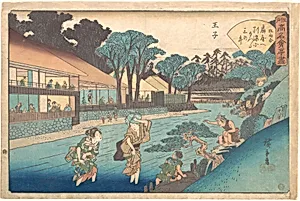
江戸高名会亭尽 王子 扇屋|The Ōgiya at Ōji
ca. 1835–42
Medium
Woodblock print; ink and color on paper
Dimensions
H. 9 3/8 in. (23.8 cm); W. 14 3/16 in. (36.1 cm)
Classification
Prints
Culture & Period
Japan · Edo period (1615–1868)
Department
Asian Art
Museum
Metropolitan Museum of Art, New York, NY
Credit
Rogers Fund, 1919
Accession Number
JP1170
Rights
Public Domain
Tags
Art Historical Context
Utagawa Hiroshige1797–1858), a master of ukiyo-e wood prints, captures the vibrant social life of Edo-period Japan in *The Ōgiya at Ōji* (ca. 1835–42). This print belongs to his series *Edo kōmei kaitei-zu* (Famous Teahouses of), celebrating popular pleasure spots where urbanites escaped daily routines. Ōji, a scenic suburb northwest of central Edo (modern Tokyo), was known for its streams and hillside teahouses like the Ōgiya, blending nature and leisure. The intimate scene features elegant women—likely courtesans or entertainers—gathered outside the teahouse amid lush greenery and a flowing stream, evoking the "floating world" of transient pleasures central to ukiyo-e culture. Hiroshige's genius shines in his subtle use of color gradients and atmospheric perspective, achieved through precise woodblock carving and layering of inks. At 9⅜ × 14¼ inches, these affordable prints brought Edo's beauty to everyday homes. Produced during the Edo period (1615–1868), when woodblock printing democratized art, this work reflects Japan's urban flourishing under the Tokugawa shogunate. Now in the Metropolitan Museum of Art's Asian Art collection (Rogers Fund, 1919), it offers a window into 19th-century Japan's blend of refined aesthetics and everyday joy.
About the Artist
Utagawa Hiroshige · 1826–1869
Utagawa Hiroshige (1797–1858), born Andō Tokutarō, was the last great master of Japanese ukiyo-e woodblock printmaking and one of the most influential landscape artists in history. Born in Edo (modern Tokyo) into a low-ranking samurai family serving as fire wardens, Hiroshige transformed landscape printmaking into a poetic meditation on nature, weather, and everyday life. His revolutionary approac...