
The Old Cock
c. 1882
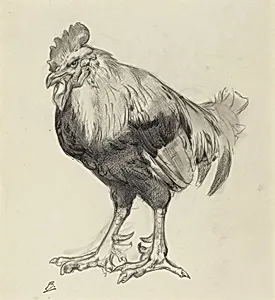
Medium
conté crayon with brush and brown-black wash on wove paper
Dimensions
overall: 41.8 x 26.2 cm (16 7/16 x 10 5/16 in.)
Classification
Drawing
Department
CG-E
Museum
National Gallery of Art, Washington, D.C.
Credit
Rosenwald Collection
Accession Number
1943.3.2103
Rights
Public Domain
Art Historical Context
Félix Bracquemond's *The Old Cock* (c. 1882) captures the weathered dignity of a rooster in a masterful drawing executed with conté crayon, brush, and brown-black wash on wove paper. Measuring 41.8 x 26.2 cm, this intimate study showcases Bracquemond's precision as a leading French printmaker and etcher of the 19th century. Associated with the etching revival and early Impressionist circles—through friendships with Manet and Degas—he infused his works with a keen eye for texture and form, often drawing from nature. The conté crayon, a versatile medium prized for its rich tonal range and durability (invented during the French Revolution), allowed Bracquemond to model the bird's feathers and contours with subtle hatching and fluid washes. Wove paper's smooth surface enhanced these effects, creating depth and luminosity typical of his preparatory sketches for prints. Roosters, symbols of vigilance and French rural life, held cultural resonance in an era of Japonisme, where Bracquemond pioneered Japanese-inspired compositions. Housed in the National Gallery of Art's Rosenwald Collection (Department CG-E), this drawing exemplifies Bracquemond's technical virtuosity and enduring fascination with everyday subjects, bridging Realism and emerging modernist sensibilities for a new generation of artists.
About the Artist
Félix Bracquemond · 1833–1914
French, Paris 1833–1914 Sèvres