
The Old Mill
1849
Medium
Oil on canvas
Dimensions
75.9 × 107 cm (29 7/8 × 42 1/8 in.)
Classification
painting
Department
Arts of the Americas
Museum
Art Institute of Chicago
Accession Number
30701
Rights
Public Domain
About this artwork
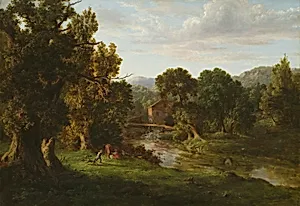
George Inness began painting landscapes during a period in which the public preferred depictions of the untamed American wilderness; throughout his career, however, he insisted upon the importance of the cultivated landscape as a subject for art. In this work, the brightly lit figures and mill contrast with the shadowy darkness of the trees, suggesting the potential for danger at the edge of the forest. The rundown mill represents a stable, settled area but also points to the changes brought abo...
Art Historical Context
George Inness's *The Old Mill* (9), an oil on measuring nearly 30 by 42 inches, captures the serene beauty of the American countryside during a pivotal era in landscape painting. Painted when Inness was just 25, this work reflects his early career influences from the Hudson River School, a movement that celebrated the sublime grandeur of the New World wilderness. The titular mill, nestled in a pastoral setting, symbolizes the harmonious tension between human industry and untamed nature—a recurring theme in mid-19th-century American art amid rapid industrialization. Inness, often called the "father of American landscape painting," drew inspiration from European masters like the Barbizon school during his formative travels. Here, his meticulous brushwork in oil— prized for its luminous depth and atmospheric effects—evokes a luminist quality, with soft light filtering through foliage to create a meditative mood. This technique underscores the era's romantic nationalism, inviting viewers to reflect on America's pastoral heritage. Housed in the Art Institute of Chicago's Arts of the Americas department, *The Old Mill* exemplifies how 19th-century painters elevated everyday scenes into profound cultural icons, bridging Transcendentalist ideals with visual poetry. A timeless gem for any visitor!
About the Artist
George Inness · 1825–1894
George Inness (1825–1894) was an American landscape painter regarded as one of the most important figures in nineteenth-century American art, bridging the Hudson River School tradition and a more personal, spiritually-inflected vision of nature. Born near Newburgh, New York, he received limited formal training, studying briefly with Régis François Gignoux, but was largely self-taught, developing h...