
The Old Mulford Farm
1929
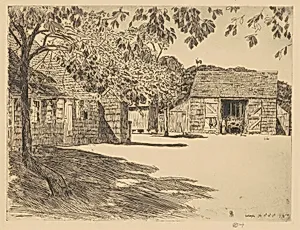
Medium
etching in black on wove paper
Dimensions
plate: 22.86 × 30.16 cm (9 × 11 7/8 in.) sheet: 28.58 × 38.74 cm (11 1/4 × 15 1/4 in.)
Classification
Department
CG-W
Museum
National Gallery of Art, Washington, D.C.
Credit
Corcoran Collection (Gift of Mrs. Childe Hassam)
Accession Number
2015.19.463
Rights
Public Domain
Art Historical Context
Childe Hassam's *The Old Mulford Farm (1929) captures the serene charm of rural America in the twilight of the artist's career. A leading figure in American Impressionism and a founding member of The Ten, Hassam was renowned for his luminous depictions of coastal landscapes and everyday scenes. Created late in his life, this etching reflects his enduring fascination with New England's historic architecture and pastoral beauty, evoking a sense of nostalgia amid the encroaching modernity of the Jazz Age. Rendered as a black etching on wove paper, the work showcases Hassam's mastery of intaglio printmaking. Etching involves biting acid into a metal plate to create fine, expressive lines, allowing for intricate textures—from weathered farm buildings to expansive fields. The modest plate size (9 × 11 7/8 in.) invites intimate viewing, emphasizing subtle tonal contrasts and atmospheric depth typical of his print oeuvre. Now part of the National Gallery of Art's Corcoran Collection, gifted by Mrs. Childe Hassam, this piece celebrates America's vanishing agrarian heritage. It stands as a testament to Hassam's versatility beyond oils, bridging fine art and print traditions for a broader audience. Visitors will appreciate its quiet poetry, a window into early 20th-century American life.
About the Artist
Childe Hassam · 1859–1935
Frederick Childe Hassam, born on October 17, 1859, in Dorchester, Massachusetts, to a family of New England descent with ties to Nathaniel Hawthorne through his mother, Rosa Delia Hawthorne, displayed an early aptitude for art. After his father's cutlery business was ruined by the Great Boston Fire of 1872, Hassam apprenticed as a wood engraver under George E. Johnson while taking drawing and wate...