
The Pantheon
1751 to 1775
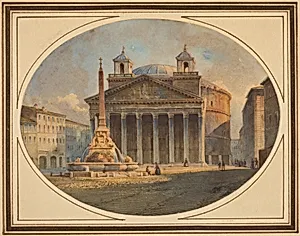
Medium
pen and brown and gray ink with watercolor and gouache over red chalk on wove paper
Dimensions
sheet: 10.4 x 13.8 cm (4 1/8 x 5 7/16 in.), oval
Classification
Drawing
Department
CG-E
Museum
National Gallery of Art, Washington, D.C.
Credit
Joseph F. McCrindle Collection
Accession Number
2009.70.176
Rights
Public Domain
Art Historical Context
Victor Jean Nicolle's *The Pantheon* (1751–1775) the majestic Roman Pantheon in a delicate oval drawing, a testament to the enduring fascination with classical antiquity during the 18 century. Nicolle, a French architect skilled draughtsman, likely created this during the height of the Grand Tour, travelers sketched Rome's ancient wonders to bring home souvenirs of imperial grandeur. The Pantheon's iconic portico and dome, symbols of Roman engineering prowess, are rendered with precise lines that evoke its timeless harmony. Executed on wove paper—a relatively new, smooth medium favored by 18th-century artists for its fine texture—this work employs pen and brown and gray ink for architectural details, layered with watercolor and gouache over red chalk underdrawing. This mixed technique allowed Nicolle to achieve depth, luminosity, and subtle color, blending meticulous draftsmanship with painterly effects typical of topographic views or *vedute*. At just 10.4 x 13.8 cm, its intimate scale invites close contemplation, much like a precious collector's gem. Housed in the National Gallery of Art's Joseph F. McCrindle Collection (Department CG-E), this drawing highlights the cultural obsession with Rome's ruins, influencing neoclassical architecture across Europe. It reminds us how such sketches preserved and popularized antiquity for enlightened audiences.
About the Artist
Victor Jean Nicolle · 1754–1826
Comment on works: Architectural views; Roman views