
The Pantheon Seen from the Piazza
1775/80
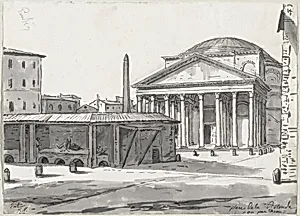
Medium
black ink and gray wash over graphite on laid paper
Dimensions
overall: 15.3 x 21 cm (6 x 8 1/4 in.)
Classification
Drawing
Department
CG-E
Museum
National Gallery of Art, Washington, D.C.
Credit
Patrons' Permanent Fund
Accession Number
1998.105.1.kk
Rights
Public Domain
Art Historical Context
Step into the sunlit Piazza della Rotonda in Rome with Jacques-Louis David's *The Pantheon Seen from the Piazza* (1775/80), a delicate drawing that captures the young artist's awe for classical antiquity. Created during David's formative years in Italy after winning the prestigious Prix de Rome in 1774, this work reflects his immersion in Roman architecture. At just 15.3 x 21 cm, it sketches the iconic Pantheon—originally a temple to all gods built by Emperor Hadrian in the 2nd century—with its grand portico and dome peeking through the bustling square, evoking the timeless grandeur that would define David's Neoclassical style. Rendered in black ink and gray wash over graphite on laid paper, the piece showcases David's meticulous draftsmanship. Graphite provides a precise underdrawing, while fluid ink lines delineate architectural details, and subtle gray washes add depth and atmospheric perspective, mimicking the play of light on ancient stone. This technique, common in 18th-century academic studies, allowed artists like David to refine their observation skills before scaling up to monumental canvases, such as his later revolutionary history paintings. Housed in the National Gallery of Art, this intimate drawing offers a window into David's evolution from student to master, highlighting how Rome's ruins fueled the Neoclassical revival. It's a reminder of art's power to bridge eras, inviting visitors to trace the Pantheon's enduring legacy through an artist's discerning eye.
About the Artist
Jacques-Louis David · 1748–1825
Jacques-Louis David, born on August 30, 1748, in Paris, emerged as the preeminent French painter of Neoclassicism, a movement emphasizing austere lines, moral clarity, and classical antiquity as antidotes to Rococo frivolity. Orphaned young after his father's death in a duel, he was raised by prosperous architect uncles and educated at the Collège des Quatre-Nations. Defying family expectations, D...