
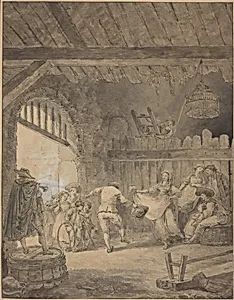
The Peasant Dance
c. 1770/1775
Medium
pen and black ink with gray and brown wash and black chalk over a black chalk counterproof, on laid paper
Dimensions
overall: 36.3 x 28.3 cm (14 5/16 x 11 1/8 in.)
Classification
Drawing
Department
CG-E
Museum
National Gallery of Art, Washington, D.C.
Credit
Samuel H. Kress Collection
Accession Number
1963.15.26
Rights
Public Domain
Art Historical Context
Hubert Robert, a masterful French artist of the late 18th century, captures the lively spirit of rural revelry in *The Pe Dance* (c. 1770/1775). Renowned for his enchanting "architectural capricciimaginary landscapes blending ancient ruins with pastoral scenes—Robert here turns his gaze to a joyous gathering of peasants dancing amid what may evoke a timeless, idyllic countryside. Created during the waning years of the Ancien Régime, this drawing reflects the era's fascination with genre scenes, evoking the earthy vitality of everyday life just before the French Revolution upended such romanticized views. The artwork's intricate medium—pen and black ink with gray and brown wash, layered over a black chalk counterproof on laid paper—showcases Robert's technical virtuosity. The counterproof technique, where an original chalk drawing is transferred in reverse onto fresh paper, allowed for subtle tonal effects and fluid reworking, lending the scene a soft, atmospheric depth. At 36.3 x 28.3 cm, its intimate scale invites close contemplation of the figures' rhythmic motion and shadowed forms. Housed in the National Gallery of Art's Samuel H. Kress Collection, this drawing exemplifies Robert's enduring influence on landscape and genre traditions, bridging Rococo elegance with emerging Romantic sensibilities. A delightful window into 18th-century imagination!
About the Artist
Hubert Robert · 1733–1808
Hubert Robert, born on May 22, 1733, in Paris, emerged from a modest background; his father, Nicolas Robert, served the influential Choiseul family, whose patronage shaped the young artist's path. After completing his studies at the Jesuit Collège de Navarre in 1751, he entered the atelier of sculptor Michel-Ange Slodtz, who taught him design and perspective before encouraging a shift to painting....