
The Penitent Magdalene
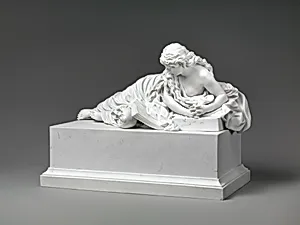
Medium
Hard-paste biscuit porcelain
Dimensions
8 3/4 × 11 13/16 × 6 7/16 in. (22.2 × 30 × 16.4 cm)
Classification
Ceramics-Porcelain
Culture
German, Meissen
Department
European Sculpture and Decorative Arts
Museum
Metropolitan Museum of Art, New York, NY
Credit
Purchase, Friends of European Sculpture and Decorative Arts Gifts, 2010
Accession Number
2010.444a, b
Rights
Public Domain
Tags
About this artwork
Christian Gottfried Jüchtzer modeled 'The Penitent Magdalene' for Meissen Manufactory circa 1783-90, taking Pompeo Batoni's late Baroque composition and giving it distinctly neoclassical aspect. This hard-paste biscuit porcelain sculpture represents Mary Magdalene in penitent pose, inspired by painter Batoni's work. The biscuit porcelain technique, visually similar to marble, was popular at Meissen for creating neoclassical sculptures during this period. Jüchtzer's modeling transformed Baroque e...
Art Historical Context
In the late 18th century, Meissen ManufactoryEurope's pioneering producer of hard-paste porcelaincommissioned sculptor Christian Gottfried Jüzer to create *The Penitent Magdalene* around 1783–. This exquisite biscuit porcelain figure captures Mary Magdalene in a moment of profound repentance, her pose drawing inspiration from Pompeo Batoni's late painting. Yet Jüchtzer masterfully reimagines it with neoclassical poise, tempering Baroque emotional fervor into serene restraint and elegant clarity, reflecting the Enlightenment-era shift toward classical ideals. The unglazed, matte "biscuit" porcelain mimics the soft luster of marble statuary, bridging ceramics with ancient sculpture traditions. Standing about 9 inches tall, this technical marvel showcases Meissen's unmatched skill in producing luxury objects for Europe's elite collectors, who prized such refined pieces amid the neoclassical revival. Today, housed in the Metropolitan Museum of Art, *The Penitent Magdalene* embodies the manufactory's artistic ambition, blending devotion, innovation, and taste in a timeless tableau of contrition and grace.
About the Artist
Meissen Manufactory|Christian Gottfried Jüchtzer · 1710–present
The Meissen Manufactory, established on June 6, 1710, by Augustus the Strong, Elector of Saxony and King of Poland, marked the dawn of true hard-paste porcelain production in Europe. Nestled at Albrechtsburg Castle in Meissen near Dresden, the Royal Polish and Electoral Saxon Porcelain Manufactory arose from alchemical experiments begun in 1708 by physicist Ehrenfried Walther von Tschirnhaus and p...