
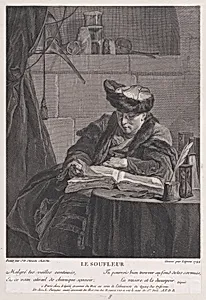
The Philosopher
Medium
Engraving
Dimensions
Sheet: 14 9/16 × 9 7/8 in. (37 × 25.1 cm)
Classification
Prints
Department
Drawings and Prints
Museum
Metropolitan Museum of Art, New York, NY
Credit
Harris Brisbane Dick Fund, 1953
Accession Number
53.600.532
Rights
Public Domain
Tags
Art Historical Context
Jean Siméon Chardin, master of 18th-century French Roc painting renowned for his intimate genre scenes and still lifes, originally created *The Philosopher* around 1744. This, skillfully executed by Bernard Lepici, reproduces Chardin's composition, capturing a contemplative man deeply engrossed in reading—evoking the archetype of the introspective scholar. The work's tags highlight themes of men and reading, reflecting the Enlightenment-era fascination with knowledge and quiet intellectual pursuit amid everyday life. As a print medium, this engraving (measuring 14 9/16 × 9 7/8 inches) played a crucial role in democratizing art during the Rococo period. Lepicié's precise technique translates Chardin's subtle textures and soft lighting into intricate lines, making the image accessible to a broader audience beyond oil paintings. Chardin's realistic yet poetic style, emphasizing humble domestic moments, contrasted with the grandeur of contemporaries like Boucher, underscoring his influence on later realism. Acquired through the Harris Brisbane Dick Fund in 1953, this piece from the Metropolitan Museum of Art's Drawings and Prints department invites visitors to ponder the timeless allure of solitary study. It reminds us how art bridges the personal and the profound, turning a simple act of reading into a philosophical meditation.
About the Artist
Jean Siméon Chardin|Bernard Lepicié|Bernard Lepicié · 1699–1779
Jean-Baptiste-Siméon Chardin, born on November 2, 1699, in Paris to a cabinetmaker father who crafted billiard tables, grew up immersed in the city's artisan world on the Left Bank near Saint-Sulpice. His early training came through apprenticeships with the history painters Pierre-Jacques Cazes, where he honed academic drawing techniques, and Noël-Nicolas Coypel, whose assignment to copy a musket ...