
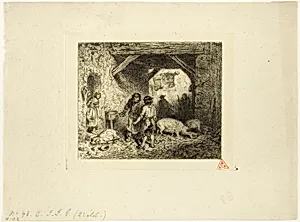
The Pig Slaughterers
Medium
Etching on ivory laid paper
Dimensions
Image: 9.8 × 12 cm (3 7/8 × 4 3/4 in.); Plate: 11.5 × 14 cm (4 9/16 × 5 9/16 in.); Sheet: 18.3 × 24.8 cm (7 1/4 × 9 13/16 in.)
Classification
etching
Department
Prints and Drawings
Museum
Art Institute of Chicago
Accession Number
45595
Rights
Public Domain
Art Historical Context
**The Pig Slaughterers** (1844) by Charles Émile Jacque captures a raw slice of rural French life through the intimate medium of etching on ivory laid paper. Measuring just 9.8 × 12 cm in its image area, this small-scale print from the Art Institute of Chicago's Prints and Drawings collection invites close viewing, revealing Jacque's masterful attention to texture and detail. As a key figure in the Barbizon School, Jacque specialized in realistic depictions of peasants and barnyard animals, drawing from his deep fascination with the countryside near Paris. Created during the 1840s—a time of social upheaval in France, including the lead-up to the 1848 Revolution—this etching reflects the unvarnished realities of agricultural labor. The title evokes the gritty communal ritual of pig slaughtering, a seasonal necessity for peasant families that sustained them through winter. Jacque's etching technique, involving acid-etched lines on a metal plate, allowed for precise rendering of fur, tools, and human forms, making multiples accessible to a wider audience beyond oil paintings. This work exemplifies 19th-century printmaking's role in democratizing art, blending technical virtuosity with ethnographic insight. Visitors will appreciate how Jacque humanizes laborious traditions, offering a poignant window into pre-industrial village life.