
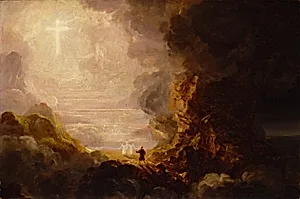
The Pilgrim of the Cross at the End of His Journey (study for series, The Cross and the World)
ca. 1846-1848
Medium
Painting
Classification
Painting
Department
Smithsonian Collection
Museum
Smithsonian American Art Museum
Credit
Smithsonian American Art Museum, Museum purchase
Accession Number
1965.10
Rights
Public Domain
Tags
About this artwork
Thomas Cole died before he was able to complete his final group of paintings, titled The Cross and the World. In the beginning of the series, two young men each begin a pilgrimage---one to the cross and the other through the world. The route to the cross is mountainous and difficult, while the pathway through the world tempts with a beautiful valley. By the end of their journeys, the pilgrim of the cross discovers the bright light and angels of redemption, but the pilgrim of the world finds only...
Art Historical Context
Thomas Cole, founder of the Hudson River School a master of American Romantic landscape painting, created *The Pilgrim of the Cross the End of His Journey around 1846–1848 as a study his unfinished series *The Cross and the World This allegorical work draws from 19th-century religious moralism, echoing John Bunyan's *Pil's Progress*. It contrasts two pilgrims: one enduring a rugged mountain path to spiritual redemption, the other seduced by a lush valley of worldly temptations. Cole's series culminates in stark moral outcomes—the faithful pilgrim reaches divine light amid angels, while the worldly one confronts desolation. In this poignant study, an aged, full-length figure stands triumphant at journey's end, bathed in heavenly vision with angels symbolizing salvation (as suggested by tags). Cole's restrained palette of muted tones heightens the dramatic glow of redemption against encroaching darkness, underscoring themes of faith's endurance over fleeting pleasures. Tragically, Cole died in 1848 before completing the series, leaving this as a powerful testament to his lifelong fusion of sublime nature and Christian allegory. Housed in the Smithsonian American Art Museum, the painting invites reflection on 19th-century America's spiritual crossroads, blending Cole's naturalistic prowess with profound ethical storytelling.
About the Artist
Thomas Cole · 1801–1848
Thomas Cole (1801–1848) was an English-born American painter who founded the Hudson River School, the first major American art movement, and became the most influential landscape painter in nineteenth-century American art. Born in Bolton, Lancashire, England, he emigrated with his family to the United States in 1818, settling first in Ohio before moving to Philadelphia and then New York, where he ...