
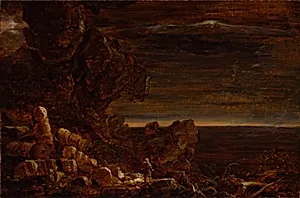
The Pilgrim of the World at the End of His Journey (study for the series, The Cross and the World)
ca. 1847
Medium
Painting
Classification
Painting
Department
Smithsonian Collection
Museum
Smithsonian American Art Museum
Credit
Smithsonian American Art Museum, Museum purchase
Accession Number
1988.1
Rights
Public Domain
Tags
About this artwork
Thomas Cole died before he was able to complete his final group of paintings, titled The Cross and the World. In the beginning of the series, two young men each begin a pilgrimage---one to the cross and the other through the world. The route to the cross is mountainous and difficult, while the pathway through the world tempts with a beautiful valley. By the end of their journeys, the pilgrim of the cross discovers the bright light and angels of redemption, but the pilgrim of the world finds only...
Art Historical Context
Thomas Cole, the pioneering founder of the Hudson River School and a master of Romantic landscape painting, crafted this poignant study around 1847 as part of his unfinished series *The Cross and the World*. Tragically, Cole passed away before completing the ambitious moral allegory, which contrasts two pilgrims' journeys: one arduous path to the Cross, symbolizing faith and redemption amid radiant light and angels, and the other seductive route through worldly pleasures, leading to desolation. This work captures the grim finale of the latter pilgrim's odyssey. In the shadowed canyon at night, an aged figure stands amid ancient temple ruins and a stark skull, evoking inevitable mortality and spiritual void. Cole's restrained palette of muted tones heightens the dramatic opposition between divine glory and faithless despair, a technique that underscores his profound religious convictions and critique of materialism in mid-19th-century America. As a preparatory oil sketch in the Smithsonian American Art Museum's collection, it exemplifies Cole's blend of sublime naturalism and biblical symbolism, inviting viewers to reflect on life's choices and the enduring quest for meaning.
About the Artist
Thomas Cole · 1801–1848
Thomas Cole (1801–1848) was an English-born American painter who founded the Hudson River School, the first major American art movement, and became the most influential landscape painter in nineteenth-century American art. Born in Bolton, Lancashire, England, he emigrated with his family to the United States in 1818, settling first in Ohio before moving to Philadelphia and then New York, where he ...