
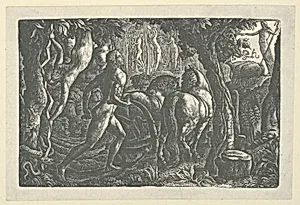
The Ploughman
1827
Medium
Wood engraving on India paper; third state of three
Dimensions
image: 3 1/4 x 5 in. (8.3 x 12.8 cm) sheet: 3 3/4 x 5 1/2 in. (9.6 x 14 cm)
Classification
Prints
Department
Drawings and Prints
Museum
Metropolitan Museum of Art, New York, NY
Credit
Harris Brisbane Dick Fund, 1931
Accession Number
31.87.35
Rights
Public Domain
Tags
Art Historical Context
Edward Calvert's *The Ploughman* (1827) captures a timeless pastoral vision through the meticulous medium of wood engraving on delicate India paper—the third and final state of three impressions. Measuring just 3¼ x 5 inches, this intimate print depicts a nude ploughman guiding a horse amid trees and a sinuous snake, evoking an Edenic harmony between man, beast, and nature. Housed in the Metropolitan Museum of Art's Drawings and Prints department, it entered the collection via the Harris Brisbane Dick Fund 1931. As a key figure in the "Ancients," a circle of artists inspired by William Blake's visionary mysticism, Calvert infused his work with Romantic ideals of innocence, labor, and biblical symbolism. Created during the early 19th century, when industrialization was reshaping Britain, *The Ploughman* idealizes rural toil as a sacred, prelapsarian act—note the serpent's subtle presence, hinting at temptation amid paradise. Wood engraving, prized for its crisp lines and durability, allowed Calvert to achieve Blakean precision on end-grain boxwood, reviving medieval techniques for modern audiences. This rare state represents the print's refined culmination, inviting visitors to ponder humanity's enduring bond with the earth.