
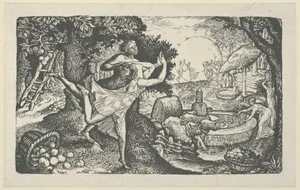
The Cyder Feast
1828
Medium
Wood engraving on India paper; third state of three
Dimensions
Image: 2 15/16 in. × 5 in. (7.5 × 12.7 cm) Sheet: 3 1/2 × 5 1/2 in. (8.9 × 13.9 cm)
Classification
Prints
Department
Drawings and Prints
Museum
Metropolitan Museum of Art, New York, NY
Credit
Harris Brisbane Dick Fund, 1931
Accession Number
31.87.36
Rights
Public Domain
Tags
Art Historical Context
Edward Calvert’s *The Cyder Feast* (1828) captures a joyful rural celebration, with men and women dancing amid baskets of ripe apples. Created during the height of British Romanticism, the small wood engraving evokes an idealized vision of pastoral life and seasonal abundance. Calvert, a member of the short-lived group known as the Ancients, drew inspiration from William Blake’s mystical approach to nature, transforming a simple harvest gathering into a scene of timeless harmony and communal delight. Printed on delicate India paper, the work demonstrates the fine detail possible in wood engraving, a technique that allowed Calvert to achieve luminous effects and intricate textures within a compact format measuring just under three by five inches. This third state of three reflects the artist’s careful refinement of the block, highlighting his meticulous craftsmanship. Though modest in scale, such prints were prized by 19th-century collectors for their poetic intensity and technical precision. Today housed in the Metropolitan Museum of Art’s Department of Drawings and Prints, *The Cyder Feast* offers visitors a glimpse into the early nineteenth-century fascination with rural traditions and the spiritual resonance of the English countryside.