
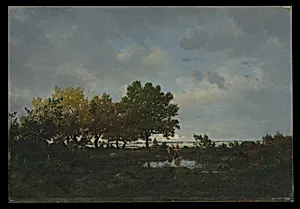
The Pond (La Mare)
Medium
Oil on wood
Dimensions
13 1/2 × 20 3/8 in. (34.3 × 51.8 cm) Framed: 23 1/2 × 29 3/4 in. (59.7 × 75.6 cm)
Classification
Paintings
Department
Robert Lehman Collection
Museum
Metropolitan Museum of Art, New York, NY
Credit
Robert Lehman Collection, 1975
Accession Number
1975.1.205
Rights
Public Domain
Tags
Art Historical Context
Théodore Rousseau's *The Pond (La Mare, painted in 1855, visitors into the intimate world of a tranquil forest waterway. This oil on wood panel, measuring just 13½ × 20⅜ inches, captures the Barbizon master's profound love for nature. Housed in the Metropolitan Museum of Art's Robert Lehman Collection since 1975, it Rousseau's commitment to depicting unidealized landscapes, a hallmark of the Barbizon School he helped lead. Rousseau, called the "father of modern landscape painting," rejected the dramatic, studio-polished vistas of Romanticism in favor of truthful, on-site observations. Created during the mid-19th century—a pivotal era when artists like him challenged academic traditions—this work reflects the Realist impulse to honor the everyday beauty of the French countryside, particularly the forests near Barbizon. The modest wood support, typical for portable plein-air studies, allowed Rousseau to achieve rich, textured effects with layered oils, evoking the dappled light and earthy tones of a secluded pond. Though small in scale, *The Pond* carries outsized significance as a precursor to Impressionism, influencing painters like Monet. Its serene composition encourages quiet contemplation, reminding us of nature's quiet power amid France's industrializing landscape. A gem for landscape enthusiasts!
About the Artist
Théodore Rousseau · 1812–1867
Théodore Rousseau (1812–1867) was a French landscape painter and the leading figure of the Barbizon School, the group of artists who settled in the village of Barbizon near the Forest of Fontainebleau to paint directly from nature. Born in Paris, he showed precocious talent and studied under the academic painters Charles Rémond and Guillaume Guillon-Lethière, but quickly rejected classical landsca...