
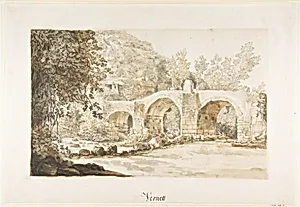
The Ponte Acquoria
18th century
Medium
Brush and brown and gray wash over black chalk.
Dimensions
11 3/8 x 18 1/8 in. (28.8 x 46.0 cm)
Classification
Drawings
Department
Drawings and Prints
Museum
Metropolitan Museum of Art, New York, NY
Credit
Harry G. Sperling Fund, 1976
Accession Number
1976.334.2
Rights
Public Domain
Tags
Art Historical Context
Joseph Vernet’s *The Ponte Acquoria* captures the quiet grandeur of an Italian landscape through the delicate medium of brush and brown and gray wash over black chalk. Created in the eighteenth century, this drawing reflects Vernet’s renowned skill in rendering atmospheric light and architectural form. As a leading French landscape artist of his time, Vernet often traveled through Italy, where he recorded bridges, rivers, and ruins with a sensitivity that bridged classical ideals and emerging Romantic sensibilities. The work’s restrained palette and fluid washes allow the structure of the bridge to emerge naturally from the surrounding terrain, demonstrating how drawings of this period served both as independent works of art and as studies for larger paintings. Measuring just over eleven by eighteen inches, the sheet rewards close viewing, revealing Vernet’s careful modulation of tone to suggest depth, texture, and the play of daylight on stone and water. Acquired by the Metropolitan Museum of Art in 1976 through the Harry G. Sperling Fund, *The Ponte Acquoria* offers today’s visitors an intimate glimpse into the eighteenth-century fascination with Italy’s historic landscapes and the technical refinement of French draftsmanship.