
The Porter
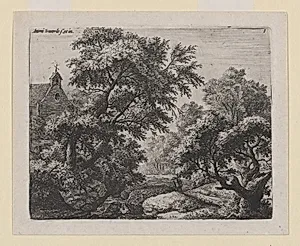
Medium
Etching; first state of four
Dimensions
Plate: 4 13/16 × 6 1/16 in. (12.3 × 15.4 cm) Sheet: 5 9/16 × 6 7/8 in. (14.2 × 17.5 cm)
Classification
Prints
Department
Drawings and Prints
Museum
Metropolitan Museum of Art, New York, NY
Credit
Gift of Anne Wikler Mininberg, in celebration of Anne's 75th birthday, 2013
Accession Number
2013.964.1
Rights
Public Domain
Tags
Art Historical Context
Step into the serene world of 17th-century Dutch landscape with *The Porter*, a delicate etching by Anthonie Waterloo (c. 1609–1690). A master etcher during the Dutch Golden Age, Waterloo was for his intricate depictions of nature, drawing inspiration from the likes of Rembrandt and the pastoral countryside around Amsterdam. This first-state impression—rare and pristine, before the plate underwent later reworkings—captures his signature focus on textured trees and atmospheric landscapes, rendered with fine, fluid lines that evoke depth and tranquility. The etching's modest plate size (4 13/16 × 6 1/16 in.) belies its technical brilliance. Etching allowed Waterloo to achieve subtle tonal variations and intricate foliage details through acid-bitten lines on a copper plate, a revolutionary technique that democratized detailed imagery via printmaking. Here, the composition likely centers a humble porter figure amid towering trees, blending human presence with the sublime power of nature—a nod to the era's fascination with rural idylls amid urban growth. Generously gifted to the Metropolitan Museum of Art in 2013 by Anne Wikler Mininberg, *The Porter* exemplifies the enduring appeal of Dutch prints: intimate, collectible windows into a golden age of artistry. Visitors will appreciate its quiet poetry, inviting contemplation of nature's enduring allure.
About the Artist
Anthonie Waterloo · 1609–1690
Anthonie Waterloo (1609–1690) was a prominent Dutch Golden Age landscape artist, born on May 6 in Lille, then part of the Spanish Netherlands. Little is known of his early life beyond his mother, Magdalena Vaillant, who joined Amsterdam's Walloon Church in 1621, with Waterloo following in 1630; no records exist of formal training, and he was likely self-taught. Registered as a painter in Amsterdam...