
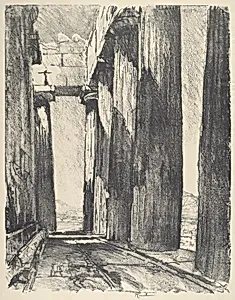
The Portico of the Parthenon
1913
Medium
lithograph
Classification
Department
CG-W
Museum
National Gallery of Art, Washington, D.C.
Credit
Rosenwald Collection
Accession Number
1943.3.6984
Rights
Public Domain
Art Historical Context
Joseph Pennell's *The Portico of thethenon* (1913) invites visitors to marvel at the majestic entrance of the ancient Greek temple atop the Acropolis in Athens. This lithographfully renders the Doric columns and architectural precision of the Parthenon a 5th-century BCE symbol of classical antiquity, democracy, and artistic perfection. Pennell, an acclaimed American artist (1857–1926) known for his architectural prints, captured its enduring power during a time when early 20th-century travelers rediscovered ancient wonders amid rising interest in classical heritage. As a lithograph—a printmaking technique using greasy crayon on limestone to create rich tonal effects—Pennell's work showcases his expertise in translating intricate details and dramatic light into fluid, atmospheric lines. Pennell championed lithography's revival in America, producing over 900 prints that celebrated monumental structures worldwide. This piece exemplifies his ability to evoke monumentality and texture, bridging ancient glory with modern precision. Housed in the National Gallery of Art's Rosenwald Collection, *The Portico* highlights the Parthenon's cultural legacy as a pinnacle of Western art, reminding us how 20th-century artists like Pennell kept its spirit alive for new generations. (198 words)
About the Artist
Joseph Pennell · 1857–1926
Joseph Pennell (1857–1926) was born in Philadelphia to Quaker parents and displayed an early aptitude for drawing, finding solace in sketching amid a challenging childhood. He received initial drawing instruction from James R. Lambdin and his first etching lessons from Stephen Ferris in 1879. Pennell attended night classes at the Pennsylvania Museum and School of Industrial Art before studying at ...