
The Priest's House, Rouen
1894/1895
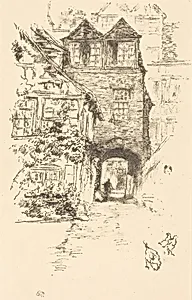
Medium
lithograph in black on laid paper
Dimensions
image: 24.1 × 16 cm (9 1/2 × 6 5/16 in.) sheet: 33 × 24.2 cm (13 × 9 1/2 in.)
Classification
Department
CG-W
Museum
National Gallery of Art, Washington, D.C.
Credit
Rosenwald Collection
Accession Number
1943.3.8734
Rights
Public Domain
Art Historical Context
James McNeill Whistler, the renowned American-born artist celebrated for his Aestheticist principles and mastery of tone and harmony, created *The Priest's House,* during a late-career trip to Normandy in 1894–1895. This intimate lithograph captures the quaint, half-timbered facade of a historic priest's residence in Rouen, France, rendered in velvety blacks on laid paper—a traditional support with visible chain lines that adds tactile authenticity. Measuring just 24.1 × 16 cm, the image exemplifies Whistler's ability to distill architectural poetry into subtle, atmospheric forms. Whistler's lithographs from this period marked a triumphant return to printmaking, a medium he championed alongside etching. Using transfer lithography—a technique where drawings on paper are transferred to the lithographic stone—he achieved painterly effects rivaling his oil nocturnes, with soft gradations and a focus on light and shadow rather than fine detail. This work belongs to his Rouen series, reflecting his fascination with medieval French architecture amid the fin-de-siècle artistic shift toward subtlety over narrative. Housed in the National Gallery of Art's Rosenwald Collection, *The Priest's House* highlights Whistler's enduring influence on modern printmaking, bridging 19th-century Romanticism and 20th-century abstraction. Visitors will appreciate its quiet elegance, inviting contemplation of everyday beauty elevated to art.
About the Artist
James McNeill Whistler · 1834–1903
James Abbott McNeill Whistler (1834-1903) was an American-born painter and printmaker who became a leading figure in the Aesthetic Movement and pioneer of Tonalism and Japonisme. He revolutionized art by championing "art for art's sake" and treating paintings as visual equivalents of musical compositions, titling works as "arrangements," "harmonies," and "nocturnes" to emphasize formal qualities o...