
The Prodigal Son, 3rd plate (L'enfant prodigue)
1826 to 1850
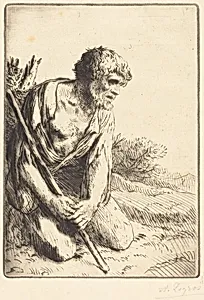
Medium
etching and drypoint
Classification
Department
CG-E
Museum
National Gallery of Art, Washington, D.C.
Credit
Gift of George Matthew Adams in memory of his mother, Lydia Havens Adams
Accession Number
1953.12.36
Rights
Public Domain
Art Historical Context
**The Prodigal Son, 3rd Plate (L prodigue)** Alphonse Legros *The Prodigal Son 3rd Plate (L'enfant prodigue)* captures a pivotal moment from the beloved Biblical parable in Luke 15, where the wayward son returns home to his forgiving father. As the third installment in a series, this etching and drypoint print, dated between 1826 and 1850, showcases Legros's mastery of intimate, narrative-driven imagery. Housed in the National Gallery of Art's of Prints (CG-E it was generously gifted by George Matthew Adams in memory of his mother, Lydia Havens Adams, highlighting its enduring appeal to collectors. Etching and drypoint were revolutionary printmaking techniques in the 19th century, allowing artists like Legros to achieve Rembrandt-like depth and texture. Etching uses acid to etch fine lines into a metal plate, while drypoint's direct needle scratches create velvety burrs for rich tonal contrasts—perfect for conveying the parable's emotional drama of repentance and reconciliation. Legros, a French artist who bridged Realism and etching revival, elevated prints from reproductive tools to expressive artworks. This piece invites visitors to reflect on themes of forgiveness and human frailty, its modest scale belying profound storytelling. A gem in the NGA's collection, it reminds us how prints democratized art, making sacred stories accessible to all. (198 words)
About the Artist
Alphonse Legros · 1837–1911
Alphonse Legros (1837–1911) was born in Dijon, France, and trained in Paris at the drawing school of Horace Lecoq de Boisbaudran, whose unconventional teaching method — which emphasised memory drawing and acute observation over academic convention — would leave a lasting mark on Legros's practice. At Lecoq's school he formed friendships with Jules Dalou and Auguste Rodin that endured throughout hi...